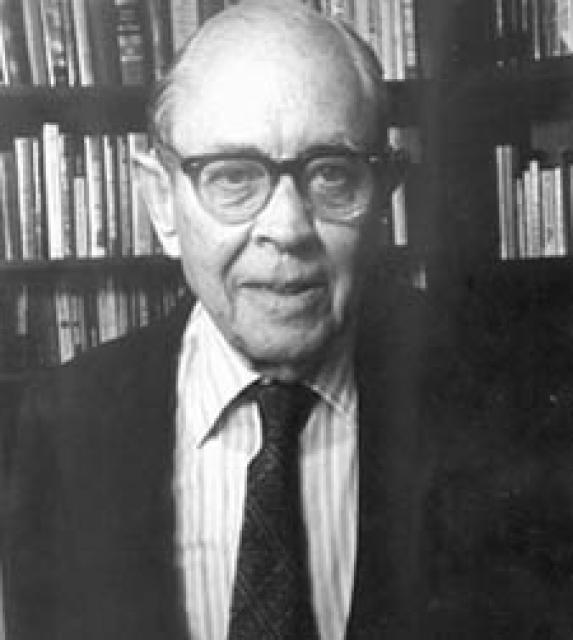
Robert Dorfman
 USA
- Education and Early Interests
- Wartime Statistics and Operations Research
- Economics and Linear Programming
- Water and Environmental Economics
- Harvard Career and Personal Life
- Legacy
Robert Dorfman began his working life as a statistician and wartime operations analyst, then became one of the economists who brought mathematical optimization into mainstream economic thinking. His research ranged from linear programming and the theory of capital to water policy and environmental economics. At Harvard, he was remembered not only for his ideas, but for the clarity with which he explained demanding technical questions.
Education and Early Interests
Dorfman was born in New York City on 27 October 1916. He studied mathematical statistics and economics at Columbia University, earning degrees in both subjects. He had once hoped to become a poet, but, as his wife Nancy later recalled, he chose mathematics as the closest alternative when he concluded that poetry was unlikely to be his profession. A lifelong interest in literature remained visible in his lucid, carefully shaped writing.
Wartime Statistics and Operations Research
Dorfman began working for the federal government in 1939. During the Second World War, he served as an operations analyst with the U.S. Army Air Forces, applying statistical reasoning to practical problems. One of his most enduring contributions came from a 1943 paper on how to find defective members of a large population efficiently.
The method pooled samples so that many people could be screened with fewer tests. If a pooled sample tested negative, the individuals in it could be cleared together; if it tested positive, follow-up testing could isolate the infected person or people. Dorfman illustrated the approach with the screening of men called up for military service for syphilis. The technique, now known as Dorfman screening or pooled testing, became useful well beyond its original wartime setting.
Economics and Linear Programming
After the war, Dorfman returned to academic study and completed a doctorate in economics at the University of California, Berkeley, in 1950. He taught there before joining Harvard in 1955. His early research took up linear programming, a mathematical method for choosing the best allocation of limited resources when production and other activities are subject to constraints.
His 1951 book, Application of Linear Programming to the Theory of the Firm, showed how the technique could be applied to business and production decisions. In 1958, he joined economists Paul A. Samuelson and Robert M. Solow in writing Linear Programming and Economic Analysis. The book connected the new mathematical methods to established economic theory and became a landmark text. Dorfman’s gift was to make formal ideas understandable without stripping away their intellectual substance.
Water and Environmental Economics
Dorfman’s interests expanded from the firm to the management of shared natural resources. In the 1960s, he worked on water allocation and planning, collaborating with engineers and other specialists. His co-authored book Design of Water Resource Systems helped bring economic analysis to decisions about water infrastructure and distribution, including projects in Pakistan.
In later decades, he became an important voice in environmental economics. He studied the costs and benefits of environmental programs and questioned how economic analysis should value effects that are difficult to measure in markets. Beginning in 1972, he and Nancy edited Economics of the Environment, a collection that helped organize and teach the developing field.
Harvard Career and Personal Life
Dorfman became the David A. Wells Professor of Political Economy at Harvard and taught there until his retirement in 1987. He served as vice president of the American Economic Association and the Association of Environmental and Resource Economists, and was elected to the American Academy of Arts and Sciences in 1972. Colleagues praised his command of theory and his ability to turn it into intuitive explanation.
He and his wife, Nancy, raised a son and a daughter. The couple also shared scholarly work, including their environmental economics readings. Dorfman died at his home in Belmont, Massachusetts, on 24 June 2002, aged 85.
Legacy
Dorfman’s career bridged several fields that are often treated separately: statistics, military operations research, mathematical economics, and environmental policy. The pooled-testing procedure associated with his name remains a practical tool, while his writing helped economists understand how optimization could illuminate production and resource allocation. His work also demonstrated that quantitative analysis could inform public decisions about water and the environment, as long as its assumptions and limits were made clear.


