Robert Goddard
 USA
USABiography of Robert Goddard
Robert Goddard was an American engineer, scientist, and inventor. He is considered the creator of the world's first liquid-fueled rocket. Despite attracting attention to his work, Goddard was not taken seriously by most people during his lifetime. It was only after his death that it became clear that he had laid the foundations for a fundamentally new branch of engineering.
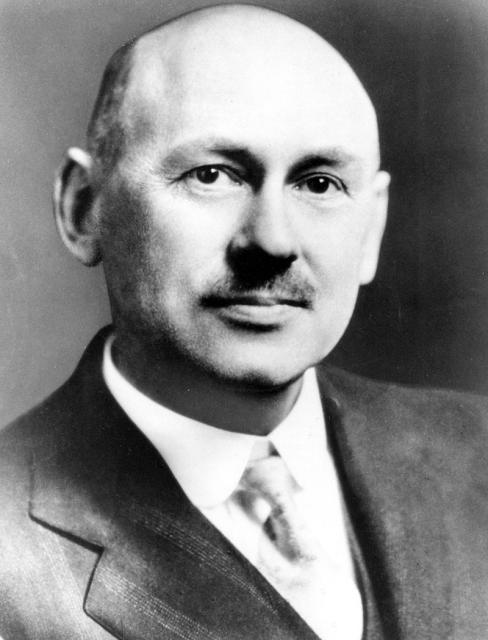
Goddard was born in Worcester, Massachusetts, to Nahum Danford Goddard and Fannie Louise Hoyt. He was the only child in the family to survive childhood; his younger brother died at a young age due to a serious spinal injury. From an early age, Robert demonstrated a keen interest in nature and the skies. He spent a lot of time with his father's telescope, observing the sky and bird flights. He was an active child and often disappeared into nature, becoming an excellent marksman during his adventures. Goddard also had a great interest in electricity, which was just beginning to be used in American cities at that time. He conducted various experiments at home, working with electricity, telescopes, microscopes, and conducting chemical experiments. Even then, Robert was drawn to the sky, although his interests at that stage did not go beyond kites and balloons. His interest in space was sparked by H.G. Wells' "The War of the Worlds".
Despite numerous health problems, Goddard managed his studies well. He suffered from stomach problems, bronchitis, colds, and various other ailments, which caused him to lag behind his peers in education by two years. In 1904, Robert enrolled at Worcester Polytechnic Institute. He quickly impressed the head of the local physics department, who made him an assistant in one of the laboratories. In 1908, Goddard obtained a bachelor's degree in physics. After working as an instructor for three years, he continued his studies at Clark University in Worcester. In 1910, he received a master's degree, and in 1911, he earned a doctorate in physics. In 1912, Robert moved to Princeton University. He came close to his first major breakthrough in 1913, but unfortunately, severe tuberculosis forced him to leave Princeton and return to Worcester for treatment. Doctors were convinced that Goddard would not survive, but he overcame the illness and completed his research.
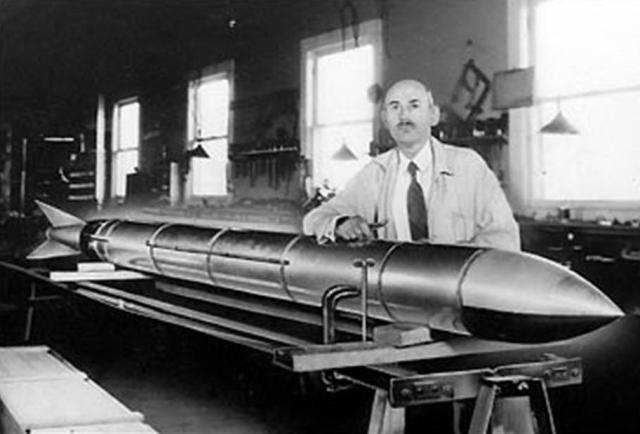
In 1914, Robert Goddard obtained two patents that were crucial for his future work – a patent for a multi-stage solid-fueled rocket and a patent for a liquid-fueled rocket. These were not his last patents – he held a total of 214 patents, some of which were granted posthumously with the help of his wife. Goddard launched the first liquid-fueled rocket on March 16, 1926, in Auburn, Massachusetts, on his Aunt Effie's farm. The rocket reached a height of 12 meters in 2.5 seconds and fell in a cabbage field, 56 meters from the launch site. While not particularly impressive, this achievement demonstrated the principle that launching rockets using liquid fuel was possible.
Goddard became famous for his theoretical research as well as his engineering work. He developed a series of components that made rocket flight possible in principle. Robert Goddard became one of the founders of modern astronautics. The concepts of multi-stage rockets and liquid-fueled rockets that he patented in 1914 still play a key role in rocketry. In 1919, he published the monograph "A Method of Reaching Extreme Altitudes," which is still considered a key work in rocketry. It was Goddard who successfully applied the concepts of three-axis control, gyroscopes, and maneuvering engines in his work. Despite his revolutionary contributions to his field, Goddard did not receive much public support for his research and development. His theories on space travel were often ridiculed in the press. As a result, Goddard became relatively reclusive and began to carefully guard the details of his work and life. He only received recognition after his death and the beginning of the space age. Robert Goddard was ahead of his time. He predicted the use of rockets for atmospheric research, ballistics, and space travel, laying a solid scientific and engineering foundation for his research.
New experiments attracted more and more attention to Goddard. While some people recognized the value of his work, such as Charles Lindbergh, who provided invaluable assistance in further experiments, Goddard also faced criticism and skepticism. Despite finding some additional financial support, the 1929 crisis made it difficult for him to find sponsors. In 1930, Goddard moved to Roswell, New Mexico, where the next 11 years proved to be the most productive period of his life. He actively developed his theories and conducted numerous launches. Compared to his German counterparts, Robert's results were not particularly convincing, but achieving great heights was never his primary goal. Goddard aimed to perfect both the rocket engine and the rocket control systems.
Knowing that his weak health would eventually catch up with him, Robert sought to make the most of his life. Working for the Navy in Maryland further worsened his health, and in 1945, he was diagnosed with cancer. Despite his illness, Goddard continued his work until his death in August 1945 in Baltimore, Maryland.