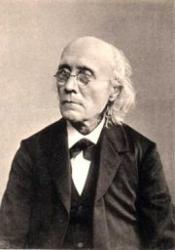
Robert Owen
 Great Britain
- Biography of Robert Owen
- Early Life and Career
- Reforms in New Lanark
- Socialist Ideals
- Experiments in the United States and Decline
- Legacy
Biography of Robert Owen
Robert Owen was a prominent English socialist-utopian who attempted to put his ideas into practice. He first implemented his vision in his own spinning factory in New Lanark, Scotland, and later in experimental communist colonies in the United States and Great Britain. Owen was the only great utopian who made an attempt, albeit based on incorrect and utopian theory, to involve the workers themselves in the socialist transformation of society.
Early Life and Career
Robert Owen was born into a middle-class family and began earning his own living at the age of ten. By the time he was twenty, he was already a director of a factory. In 1800, Owen co-managed a large textile enterprise in New Lanark, Scotland. His activities in New Lanark gained him recognition as a philanthropic factory owner.
Reforms in New Lanark
Owen introduced a relatively short working day of 10.5 hours at the factory, established nurseries, a kindergarten, and a model school for children and workers, and implemented measures to improve the working and living conditions of the workers. In 1815, Owen proposed a law that limited the working hours for children and mandated compulsory schooling for working children. In 1817, he presented a report to a parliamentary commission, in which he advocated for the concept of labor communities as a means to combat unemployment.
Socialist Ideals
By 1820, Owen's social ideas had fully formed. He believed in the necessity of a radical reconstruction of society based on communal ownership, equal rights, and collective labor. Owen envisioned a future "rational" society as a free federation of small self-governing socialist communities, each consisting of no more than 3,000 people. The main occupation in these communities would be agriculture, but Owen opposed the separation of industrial work from agricultural work (the communities would also organize industrial production). In a society with communal ownership and collective labor, there would be no exploitation or classes. Work would be distributed among citizens according to their needs. Owen, influenced by 18th-century French materialists, believed that human character is a product of the social environment, and in his new society, a new type of person would emerge. Proper education and a healthy environment would teach individuals to think and feel rationally and eradicate selfish habits. According to Owen, courts, prisons, and punishment would no longer be necessary.
Experiments in the United States and Decline
Owen believed that establishing one community would be sufficient, and its advantages would inevitably lead to the organization of others. In 1824, he traveled to the United States to organize an experimental colony based on communal ownership. However, all of Owen's experiments in the United States only proved the impracticality of his plans. After a series of failures, Owen returned to England, where he actively participated in the cooperative and labor movement. Alongside his reorganization efforts, Owen advocated for a comprehensive and utopian restructuring of production as a peaceful transition to a socialist system. He believed that trade unions could take control of the corresponding industries and organize production on cooperative principles without resorting to any violent measures. In 1834, the "Grand National Consolidated Trades Union" was established with the goal of implementing Owen's plan. However, the realities of capitalism shattered Owen's utopian hopes. Several organized lockouts by entrepreneurs, unsuccessful strikes, and harsh judicial sentences resulted in the dissolution of the "Grand Union" in the same year.
Legacy
The failure of the "Grand Union" marked the decline of Owenism. Although Owen and most of his supporters condemned the political struggle of the working class, they remained aloof from the powerful class movement of the English proletariat known as Chartism and held a negative view of it. Nevertheless, Owen's contributions were significant. He preached socialist ideas for forty years and dedicated his entire conscious life to serving the interests of the working class and fighting for factory legislation and improved working conditions. Owen was the only great utopian who made an attempt, albeit based on incorrect and utopian theory, to involve the workers themselves in the socialist transformation of society.