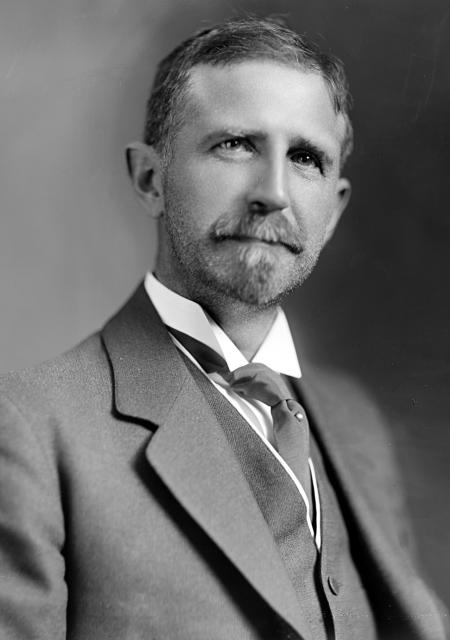
Roger Ward Babson
 USA
USA- Biography of Roger W. Babson
- Early Life and Education
- Career
- Financial Predictions and Legacy
- Later Life and Legacy
Biography of Roger W. Babson
Roger W. Babson was an American financial analyst, renowned for his expertise in analyzing and consulting on various topics such as business, education, healthcare, industry, politics, religion, social conditions, and travel. His primary focus, however, was on reforms and finding ways to improve different aspects of life.

Early Life and Education
Roger Ward Babson was born in 1875 in Gloucester, Massachusetts to Nathaniel Babson and Ellen Stearns. He was the tenth member of the Babson family, who had been living in Gloucester for generations. From an early age, Roger showed exceptional entrepreneurial skills, willingly taking on any task or assignment for even the smallest fee. However, he always expected to be compensated for his work. Despite his father's desire for him to become an engineer, Roger graduated from the Massachusetts Institute of Technology (MIT) at his father's insistence.
Career
After completing his education, Babson initially worked as a clerk in a bank, eventually advancing to bond sales. In 1904, he founded his own firm, Babson's Statistical Organization. His tuberculosis diagnosis played a significant role in starting his own business, as it allowed him to work from home while receiving treatment. During this time, Babson married Grace Margaret Knight in 1900, and they had a daughter named Edith in 1903.
Throughout his life, Roger Babson wrote numerous works on a wide range of topics, including business, education, healthcare, industry, politics, religion, social conditions, and travel. However, his main focus was always on reforms and finding ways to improve various aspects of life.
Financial Predictions and Legacy
In the late 1920s, many influential figures in the financial world began to worry about the fate of the stock market and the industrial boom. Roger Babson, who had achieved great success in politics, church activities, education, and science, and was a respected investment consultant, also attempted to forecast and analyze the prevailing financial situation. In his famous speech delivered in 1929 at the Annual National Business Conference, Babson became known for being the first person to predict the impending stock market crash. He advised people to sell stocks and buy gold, stating, "I repeat what I have said at this time in past years, namely that sooner or later the leading stocks will... collapse." Unfortunately, his predictions were soon proven correct.
Babson was regarded by many as eccentric and even foolish due to his method of analyzing the economy, in which he applied the laws of physics, such as Newton's law of action and reaction. Despite criticism, many of his methods became widely used in financial forecasting. For example, his division of the business cycle into four distinct periods - improvement, prosperity, recession, and depression - is now well-known to modern analysts, although it was not widely accepted in the 1920s. However, Babson made a miscalculation when predicting the recovery from the crisis, believing that the country would regain necessary business activity by the end of 1930, which did not happen.
Later Life and Legacy
In 1940, Roger Babson ran for president in the 1940 elections but lost to Franklin Delano Roosevelt. In 1948, he founded the Gravity Research Foundation. Babson's most well-known books include "Business Barometers" and "Business Barometers for Profits, Security, Income." After the death of his first wife in 1956, he remarried Nona M. Dougherty, who passed away in 1963.
Roger Babson died on March 5, 1967, leaving behind a legacy of financial analysis, consulting, and a unique approach to economic forecasting. His insights and predictions continue to be studied and analyzed by future generations.