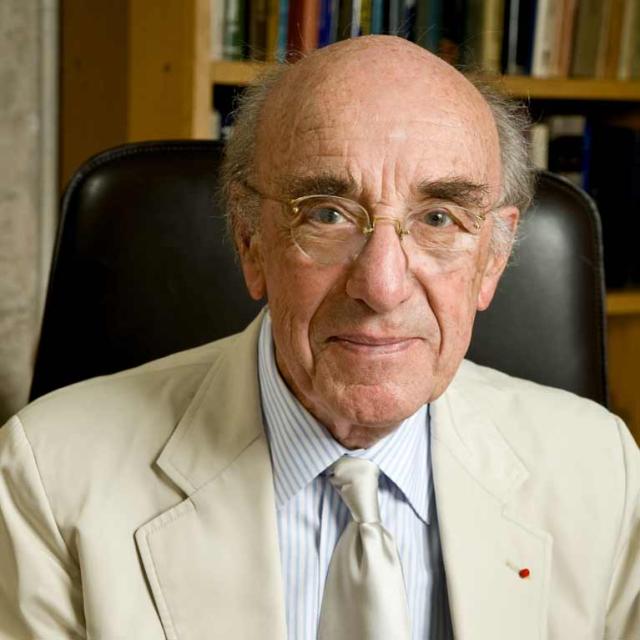
Roges Guillemin
 France
Biography of Roger Charles Louis Guillemin
Roger Charles Louis Guillemin, a Franco-American physiologist, was born in Dijon, France to Raymond and Blanche Guillemin. He received his secondary education in public schools in Dijon, and in 1942, he completed his bachelor's degree in arts and sciences at the University of Dijon. In 1943, he enrolled in medical school and pursued a program jointly developed by the medical faculties of the University of Dijon and the University of Lyon. However, he did not have the opportunity to conduct research during this time.
After completing his three-year clinical training, similar to an internship, he had a short medical practice. From 1940 to 1944, he participated in the Resistance movement during the Nazi occupation of France. In 1948, after attending a lecture by Canadian physiologist and stress specialist Hans Selye, Guillemin convinced him to take him on as an assistant at the Institute of Experimental Medicine and Surgery at the University of Montreal. There, Guillemin began experimental studies on arterial hypertension, which formed the basis of his dissertation, which he defended at the medical faculty in Lyon in 1949, earning his medical degree. The following year, Guillemin returned to Montreal to conduct research in the field of experimental endocrinology, studying the role of the hypothalamus in controlling pituitary hormone secretion.
In the 1950s, British physiologist Geoffrey Harris discovered that the secretory activity of the anterior pituitary was reduced when the portal vessels were severed. Based on this, he hypothesized that the activity of the pituitary gland is regulated by chemical substances, or hormones, transmitted through the blood, with the hypothalamus as the source. As these hypothalamic hormones had not been isolated at that time, Guillemin decided to tackle this problem.
In 1953, Guillemin was offered a position as an assistant professor of physiology at the Baylor College of Medicine in Houston, Texas, which he accepted. Two years later, his colleague Andrew V. Schally discovered the first of the hypothalamic hormones, which he called corticotropin-releasing factor (CRF). Guillemin and Schally continued to compete with each other and came close to isolating three more hypothalamic hormones. Guillemin faced difficulties in obtaining sufficient hypothalamic tissue for extracting the hormones, as the amounts produced in the body were minute. He used sheep hypothalami, obtaining them from the slaughterhouse immediately after the animals were killed to prevent the degradation of hormones.
In 1968, Guillemin and his colleagues isolated the hypothalamic hormone that stimulates the release of thyrotropin from the pituitary gland, which was named thyrotropin-releasing hormone (TRH) by Schally. They determined that TRH is a peptide composed of three amino acids. In the late 1960s, they also isolated the hypothalamic hormone that stimulates the release of gonadotropins, which control the secretion of male and female sex hormones by the testes and ovaries. Another hypothalamic hormone known as somatostatin, which inhibits the release of growth hormone from the pituitary gland, was isolated by Guillemin and his colleagues in 1970. They found that somatostatin is a peptide composed of 14 amino acids.
In 1970, Guillemin joined the Salk Institute in San Diego, California, where he and his colleagues continued their research on neuropeptides, specifically endorphins and enkephalins. For their discoveries related to the secretion of brain peptides, Guillemin and Schally shared the Nobel Prize in Physiology or Medicine in 1977 with Rosalyn S. Yalow. Guillemin's research has paved the way for a fundamental reevaluation of the mechanisms of brain function and mental illnesses.
Guillemin has been a member of various scientific organizations and has received numerous awards and honors for his work. He is a member of the National Academy of Sciences, the American Academy of Arts and Sciences, the American Physiological Society, and other prestigious scientific societies. He holds honorary doctorates from several universities, including the University of Rochester, the University of Chicago, and the University of Montreal. Guillemin has made significant contributions to the field of neuroendocrinology and continues his research at the Salk Institute.
In 1951, Guillemin married Lucienne Jeanne Bieyar, and they have one son and five daughters.