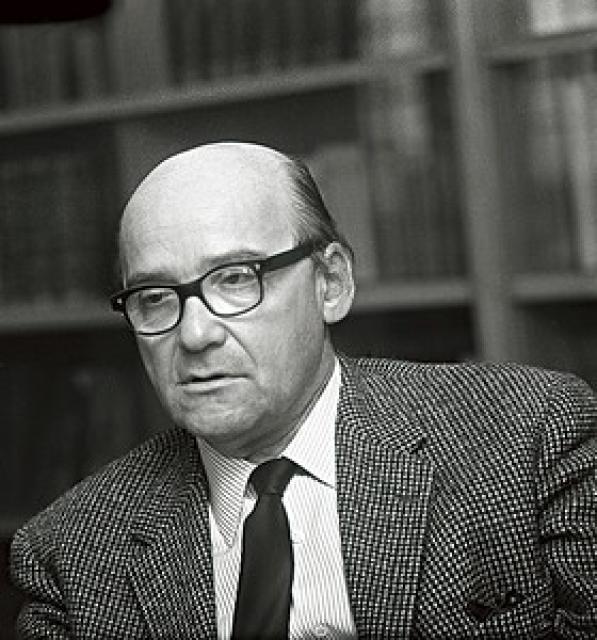
Roman Brandstaetter
 Poland
- Roman Brandstaetter: Polish Literary Luminary
- Literary Debut and Parisian Scholarship
- Return to Poland and Literary Contributions
- World War II and Postwar Years
- Collaboration with Polish Radio and Conversion to Catholicism
- Return to Europe and Literary Production
- Return to Poland and Postwar Career
- Translation Masterpieces and Prose Works
- Death and Legacy
Roman Brandstaetter: Polish Literary Luminary
Early Life and EducationRoman Brandstaetter was born into an esteemed Jewish family in Tarnów, Poland, in 1906. His uncle, Mordechai David Brandstaetter, was a renowned Hebrew novelist known as the "forerunner of modern Hebrew literature." In 1924, Roman graduated from gymnasium in Tarnów and matriculated at the prestigious Jagiellonian University in Kraków, where he pursued studies in philosophy and Polish philology. It was during his university years that his poetic talent first emerged, with the publication of "Elegy on the Death of Sergei Yesenin" in the literary magazine "Courier."
Literary Debut and Parisian Scholarship
In 1928, Brandstaetter released his debut poetry collection, "Jarzma" (Bonds). Upon graduating with honors, he was awarded a state scholarship to continue his studies in Paris. From 1929 to 1931, he delved into the political and social thought of Adam Mickiewicz, earning his doctorate in philosophy in 1932.
Return to Poland and Literary Contributions
After completing his studies in Paris, Brandstaetter returned to Poland and settled in Warsaw in 1932. He worked as a Polish language teacher and edited the literary magazine "Courier." During this period, he published several works of historical and literary scholarship, including "The Jewish Legion of Adam Mickiewicz" (1932), "Moszkopolis" (1932), "Anti-Jewish Excesses of the Students of Vilnius University in 1815" (1932), and "The Tragedy of Julian Klaczko" (1933). His poetry collection "Węzły i miecze" (Knots and Swords) and the pamphlet collection "Zmowa eunuchów" (Conspiracy of the Eunuchs) were also published during this time.
In 1935, Brandstaetter embarked on a journey to Turkey, Greece, and Palestine.
World War II and Postwar Years
Escape to Vilnius and JerusalemShortly after the outbreak of World War II, Brandstaetter relocated to Vilnius. There, in 1940, he married Tamara Karen, a Jewish woman he had known in Warsaw. After a brief stay in Vilnius, the couple fled to Moscow, Baku, Iran, and Iraq, eventually settling in Jerusalem. During this period, Brandstaetter wrote his first drama, "Kupiec warszawski" (The Warsaw Merchant).
Collaboration with Polish Radio and Conversion to Catholicism
In Jerusalem, Brandstaetter initially worked for Hebrew publishing houses and media outlets, as well as the theater. With the help of his former professor, Stanisław Kot, he secured a position with the Polish Radio (Polska Agencja Telegraficzna). It was during this time that Brandstaetter underwent a profound spiritual transformation, culminating in his conversion to Catholicism. In 1945, he divorced his first wife and married the secretary of the Polish ambassador to Rome, also named Tamara.
Return to Europe and Literary Production
In 1946, Brandstaetter traveled to Rome and continued his literary career. He produced several plays, including "Oedipus" (1946), "Noce narodowe" (National Night) (1946/1947), and "Przemysław II" (1948). Inspired by the figure of Saint Francis of Assisi and the beauty of Assisi, he wrote "Kroniki Assyżu" (Chronicles of Assisi) (1947) and "Teatr świętego Franciszka" (Saint Francis' Theater) (1947). From 1947 to 1948, he served as the cultural attaché at the Polish embassy in Rome.
Return to Poland and Postwar Career
Upon his return to Poland in 1948, Brandstaetter emerged as a prominent figure in the literary landscape. He was appointed literary director of the Polish Theater and later the Grand Theater in Poznań. He also served as vice president of the Poznań branch of the Writers' Union. In 1950, he moved to Zakopane, where he became the city council's chairman for cultural affairs. During this period, he became a member of PEN International and wrote the libretto for Tadeusz Szeligowski's opera "Bununt Żaków" (1951). He also translated several works of Shakespeare into Polish.
Translation Masterpieces and Prose Works
In 1956, Brandstaetter was elected a corresponding member of the Académie Rhodanienne des Lettres. He returned to Poznań in 1960, devoting himself exclusively to literary pursuits. He produced numerous plays, poetry collections, and translations, including the monumental translation of the New Testament into Polish. Brandstaetter's prose works reached their peak during this period, with the publication of the historical novel "Jesus of Nazareth" (1967-1973), the novella "Ja jestem żyd z Wesela" (I Am a Jew from the Wedding), and several collections of literary miniatures.
Death and Legacy
Roman Brandstaetter passed away in Poznań on September 27, 1987. He was laid to rest in the Miłostowo Cemetery. Posthumous publications included the poetry collection "Hamlet i łabędź" (Hamlet and the Swan) (1988), the short story collections "Przypadki mojego życia" (Incidents from My Life) (1988) and "Moja podróż sentymentalna i inne opowiadania" (My Sentimental Journey and Other Stories) (1994).
Considered one of the greatest Polish literary figures of the 20th century, Roman Brandstaetter left behind a vast and diverse body of work that spans poetry, drama, translation, and prose. His contributions to Polish culture and his transformative journey of faith continue to inspire readers and scholars alike.




