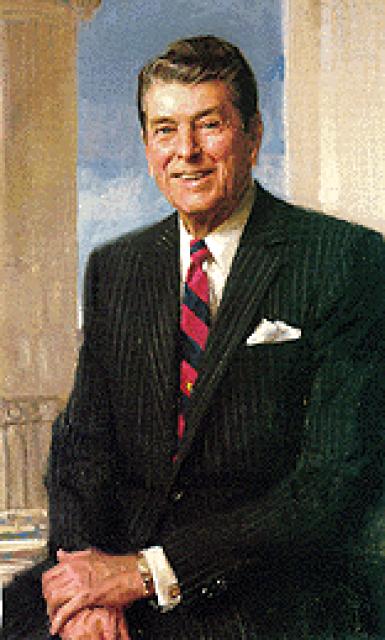
Ronald Reagan
 USA
USABiography of Ronald Reagan
Ronald Wilson Reagan was born on February 6, 1911, in Tampico, Illinois, to a family of modest means. His parents, grandparents, and great-grandparents were of Irish, Scottish, and English descent. He spent his childhood and youth in small provincial towns in Illinois, including the town where he was born, as well as in Monmouth, Dixon, and finally, Eureka, where he attended college from 1928 to 1932. This region of the United States in the Midwest allowed the young growing man to internalize the fundamentals of American ideology: individualism, the belief that everyone is the architect of their own happiness, and a deep skepticism of the central government in distant Washington.
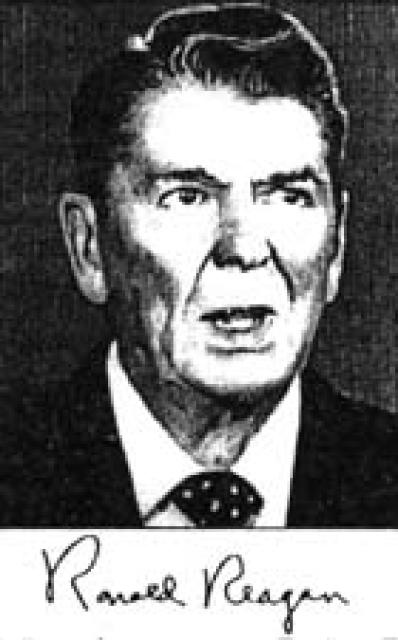
After graduating from college, Reagan became a sports commentator, first for one year at a small radio station in Davenport, Iowa, and then at a larger NBC radio station in Des Moines, Iowa. These were years of learning the craft, for which Reagan ultimately gained a reputation as a "great communicator." In 1937, he moved to Hollywood, where his 30-year career in film and television began. In the early years of his political development, it was also important that he became an active union leader and, in 1947, the president of the Screen Actors Guild. This activity taught him negotiation skills (including tariff negotiations) and developed his instinct for when to remain steadfast and when to compromise.
In 1952, Reagan married his colleague, actress Nancy Davis. Two years later, he began working on contract for General Electric (GE), hosting the television program "General Electric Theater." The contract also included the provision that Reagan should travel to the company's production departments for 16 weeks a year to speak at production meetings and thus improve the production climate and stimulate the identification of employees with the company. His standard speech also included political appeals: he emphasized the importance of the individual, praised the ideals of American democracy, warned against the communist threat, and the dangers of a rapidly growing social state. In 1962, Reagan, who initially considered himself a Democrat in the spirit of Roosevelt, officially changed his party affiliation and became a Republican. It was no coincidence that an experienced media personality like Reagan ran for governor of California in 1965-66: in comparison to other states, the personalization of politics had progressed significantly, and parties played a relatively small role. Although (or perhaps because) Reagan was known as a supporter of Barry Goldwater, the ultra-conservative Republican candidate who failed in the 1964 presidential election, he conducted a moderate but clearly conservative campaign. He advocated for a return to traditional values, law and order in dealing with concerned students and universities, the reduction of the California state budget, and transferring responsibility back to the communities and citizens. During his 8 years as governor of California, many distinct characteristics of his leadership style and policies emerged, which later characterized his presidency. He led the executive branch as chairman of the Board of Governors, emphasized his conservative principles, knew how to set priorities, but did not interfere in the administrative and legislative processes. The governor directly addressed the voters to put pressure on both chambers of the legislature. In controversial cases, he acted pragmatically, made compromises, and found majorities. Despite his conservative campaign rhetoric, taxes increased, the state budget doubled, and the number of government employees did not decrease during his two terms as governor.
Again, Reagan's skills as a media specialist and communicator paved his way to the White House. His astute performance as a citizen politician resonated strongly within the Republican Party. After losing the nomination to President Gerald Ford in 1976 with 111 delegate votes (out of 2,257) at the Republican convention, he won 29 out of 34 primaries in 1980 and succeeded at the party congress. Reagan's great success as an orator was also due to his rhetoric being based on fundamental convictions. He was an actor with political principles who knew how to identify himself and his policies with American values and traditions. His personal qualities included calm self-confidence and optimism.
His energetic manner and a flood of personnel and political decisions in the first few months after his election heightened the impression that a political shift had occurred with the inauguration of the new president, even sparking a "conservative revolution." Reagan's greatest achievement was to restore lost faith in the institution of the presidency as the place where national policy is formed and implemented. In an interview with "Vogue," the president explained that his method of leadership involved surrounding himself with exceptional individuals, maintaining authority, and staying out of the way while his policies were implemented correctly. Indeed, the president was detached from the daily administrative affairs, which initially worked excellently but, in his second term, led to the Iran-Contra scandal, clearly showing that the president was no longer in control of the White House.
Reagan and his closest advisors were well-prepared for the presidency, as demonstrated by their personnel policy in 1980/81. Special attention was given to ensuring that below the level of the cabinet were presidential envoys who pursued White House policy. These high-ranking officials were extensively trained by Reagan's trusted associates before they moved into their ministries. Three hundred of the most important appointments were based on party affiliation, which had not been the case since 1960: over 80% of all newly appointed officials were Republicans, with only 3% being Democrats (among them, conservative woman Jean Kirkpatrick, the ambassador to the United Nations). In this area, the second term of the presidency marked a turning point, as corruption played an increasingly prominent role. By the end of 1986, over 100 members of the Reagan administration had been fired or were under investigation for corruption.
In his first term, Reagan was surrounded by two circles of advisors. The inner circle was the so-called "troika," consisting of James Baker as chief of staff, Ed Meese as chief of staff to the president, and Michael Deaver as responsible for public relations. The second circle consisted of those who reported to the troika but did not have direct access to the president. In 1980, Reagan's presidency seemed like a "conservative revolution" due to his skillful leadership and the content of his policies. However, his second term marked a shift, especially with the Iran-Contra scandal and the increasing corruption within his administration. Despite this, Reagan's legacy is often associated with his strong conservatism, his ability to communicate effectively, and his impact on American politics.