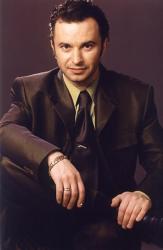
Roy Orbison
 USA
USABiography of Roy Orbison
Roy Kelton Orbison was born on April 23, 1936, in Vernon, Texas. Despite his parents' professions as a nurse and a worker, they were not involved in music. However, his father loved to play the guitar and sing with his friends in his free time. On his sixth birthday, Roy received a guitar as a present from his father, which determined his future. He quickly learned to play and soon started performing in improvised home concerts. At the age of eight, Roy wrote his first song called "A Vow of Love." A year later, he won a local talent competition and received an invitation to perform on a Saturday show on a local radio station. In late 1946, the Orbison family moved to Wink, where a few years later, Roy formed his first band called Wink Westerners. Even though he was only 13 years old, the band became surprisingly successful. They were invited to perform once a week on the local radio station KERB. Over time, the ensemble expanded its repertoire, playing instrumental compositions and big band standards. Roy Orbison was an incredibly active and energetic teenager. During summer vacations, he worked as a laborer, taking on the toughest jobs. Alongside his school studies, he played in an orchestra that performed marches, sang in an octet, and learned to play the trumpet. In his senior year, he even became the manager of the school football team. In 1953, the Wink Westerners started performing in city clubs and soon embarked on their first modest tour of West Texas. After graduating from high school, Roy Orbison moved to Denton, where he enrolled in college. Together with two classmates, he made his first professional recording, a composition called "The Ooby Dooby." However, the promised contract with Columbia Records never materialized. In 1955, Orbison enrolled in a two-year college in Odessa. Initially, he planned to study geology but instead chose history and English. In Odessa, the other members of the Wink Westerners also gathered. After a few lineup changes and a name change to The Teen Kings, they started performing in clubs with a rock 'n' roll repertoire. They even had their own Saturday show on local television, where famous guests would appear. Elvis Presley and Johnny Cash even interviewed Roy Orbison. Local entrepreneur Weldon Rogers, who had just created his own record label called Je-Wel, agreed to provide studio time to Roy Orbison. With The Teen Kings, Roy recorded two songs: "Ooby Dooby" and a cover version of Clover's song "Trying to Get to You." Two weeks after the studio sessions, a double single was released. The record fell into the hands of Sun Records boss Sam Phillips, who immediately tracked down the musicians and invited them to Memphis, where they recorded three of their compositions. They then embarked on a trial tour of the southern states, opening for famous artists such as Johnny Cash, Carl Perkins, Warren Smith, Jerry Lee Lewis, and others. The tours were not in vain, as the single "Ooby Dooby" reached the 59th position on the pop chart. However, subsequent singles released by Sun Records received no response. In December 1956, The Teen Kings disbanded, and Roy Orbison decided to focus on developing his songwriting skills. In 1958, a new chapter in the musician's biography began when the Everly Brothers recorded his composition "Claudette," which Roy dedicated to his wife Claudette. Although it was released as a B-side, it reached the American Top 30 charts, and Orbison's songs started appearing in the repertoire of Buddy Holly, Rick Nelson, and Jerry Lee Lewis. This significantly raised his profile as a songwriter. Tracks performed by Orbison himself, such as "Uptown" and especially "Only the Lonely," which stood out with their orchestral arrangements and allowed him to showcase his charming baritone, gained even more recognition on the charts. The single "Only the Lonely" quickly reached the second position on the American charts and became a number one hit in the UK. During this time, Orbison began recording for the new independent label Monument Records with producer Joe Melson. Orbison was incredibly fortunate with his recording bosses. Fred Foster, the head of the label, did not chase quick success and provided the singer with studio time without any guarantee of future profits. This allowed Orbison to experiment and ignore market demands. In the end, he won. Roy Orbison grew into a unique artist who performed a one-of-a-kind repertoire that was original in structure, sound, and style. Orbison himself began dictating the musical fashion, creating fresh, quasi-symphonic orchestrations in which his distinctive vocals and guitar were accompanied by haunting strings, ominous drums, and enchanting backing vocals. Hits followed one after another, such as "Crying," "Candy Man," "Dream Baby," "Working for the Man," "Leah," "In Dreams," "Pretty Paper," "Blue Bayou," "Mean Woman Blues," and "It's Over." These songs spent at least five years in the American Top 40 and made Roy Orbison one of the biggest stars in the global pop scene and a top artist in the United States. In May 1963, Orbison accepted an offer to tour the UK with the Beatles, who were just starting their stellar careers. Tickets for all their concerts sold out within days. On the first night, the audience refused to let Orbison leave the stage and demanded 14 encores. John Lennon later admitted that when he was writing songs for the Beatles' first album "Please Please Me," he aimed to surpass Roy Orbison. Orbison could compete with the Beatles, and he was one of the few who withstood the wave of the so-called British Invasion. In 1964, he released his biggest hit in his career, the song "Oh Pretty Woman." It was co-written with his new partner Bill Dees. The song "Oh Pretty Woman" is not only a peak in Orbison's biography but also one of the most famous and iconic songs of the rock era. The single was released in August 1964 in the United States and a month later in the UK and other countries. It consistently reached number one in every country where it was released. Within a few months, before the end of 1964, the single "Oh Pretty Woman" had reached seven million listeners worldwide. Studio success was reinforced by regular and extremely successful tours, which allowed Orbison to showcase the power and beauty of his magnificent voice live. In 1964, Orbison toured Australia with the Beach Boys, and in 1965, he shared the stage with the Rolling Stones. He also made several trips to Europe. When his contract with Monument Records expired, Orbison became a sought-after artist for record labels. The head of MGM Records offered him a million-dollar contract. Although his debut on the new label, the single "Ride Away," only reached the 25th position on the pop chart, it became his most successful release in the US in the next twenty years. Unfortunately, the million-dollar contract took away his creative freedom. For MGM Records, one of the market leaders, Roy Orbison was just another artist subject to general rules, pursuing quantity over quality. He was forced to release a certain number of singles and albums, which affected the quality of his recordings and subsequently his popularity. Orbison's life entered a very difficult period. Professional failures were only part of it. In 1966, his wife Claudette died in a car accident after nine years of marriage. Two years later, another tragedy struck when two of his three children died in a fire that destroyed his home. For several years, Orbison was unable to write music but continued to tour and appear in movies, including starring in the film "The Fastest Guitar Alive." Barbara Anne Marie Wilhonnen Jacobs, a young German woman whom Orbison met in England, helped him overcome this crisis. Barbara moved to America, and they married in May 1969. In 1974, Orbison signed with Mercury Records. However, it did not bring back his former popularity. Although some of his songs, such as "Penny Arcade" and "Too Soon to Know," had success in specific markets, his albums and singles were relatively lackluster in sales for over twenty years, from the late 1960s to the late 1980s. In January 1978, he underwent heart surgery. However, just three weeks later, he performed his first concert, proving to himself and others that he still had fight left in him. Meanwhile, there was a glimmer of hope in America. While not in demand as a performer, Roy Orbison always remained a popular songwriter and one of the most beloved authors. Cover versions of his songs became hits one after another. Linda Ronstadt's release of "Blue Bayou" sold eight million copies, and Van Halen's new version of "Oh Pretty Woman" was also a huge success. Don McClean's rendition of "Crying" became one of the biggest hits in Don McClean's career. With the beginning of the 1980s, Orbison's career experienced an evident turning point that gradually restored his reputation as a relevant artist. In 1980, he won his first Grammy Award for Best Country Performance with the track "That Lovin' You Feelin' Again," which he shared with Emmylou Harris. His beautiful song "Wild Hearts Run out of Time" was featured in the well-known film "Insignificance." In 1986, the album "Class of '55" was released, recorded with labelmates from Sun Record. The album earned Orbison another Grammy Award in the category of Best Spoken Word Album. Orbison's popularity was also boosted by his song "In Dreams," which appeared on the soundtrack of the cult film "Blue Velvet." In January 1987, Roy Orbison's name was inducted into the Rock and Roll Hall of Fame. He then signed a new contract with Virgin Records, which included the release of the greatest hits compilation "In Dreams-Greatest Hits." Orbison prepared several fresh tracks for the album, written with new collaborators, including Jeff Lynne. Among the live albums released during his 25-year career, there were several successful ones, such as "Roy Orbison at the Los Angeles Country Club" and "Live in Birmingham, Alabama." However, none could compare to the album "Roy Orbison and Friends - A Black and White Night Live" (1989). The album was recorded with a fabulous lineup, including Bruce Springsteen, Elvis Costello, Tom Waits, Bonnie Raitt, T-Bone Burnette, Jackson Browne, and Elvis Presley's backing band with James Burton on guitar. The single released from the album, "Crying," a duet with k.d. lang, earned Orbison another Grammy. Orbison's collaboration with Jeff Lynne, which was already interesting in itself, had even more significant consequences. Lynne was also producing George Harrison, Tom Petty, and Roy Orbison simultaneously. This led to the formation of the supergroup Traveling Wilburys, which also included Bob Dylan. The group's first album, released shortly after, reached the top 10 in the US charts. Meanwhile, Roy Orbison finished working on a collection of new material. The release was planned for January 1989, followed by tours in America and Europe. In November, he headlined the Belgian Diamond Awards Festival, where he performed the beautiful new composition "You Got It." On December 6, 1988, in Nashville, while visiting his mother, Orbison felt unwell after a shopping trip and died a few hours later from a heart attack. He was only 52 years old. Within a month, Roy Orbison's name returned to the top of the charts. The single "You Got It" quickly rose to the ninth position on the Billboard Hot 100 chart. The new album "Mystery Girl" reached the top five on the pop album chart and became Orbison's best-selling album of his career. In 1992, Virgin Records released a collection of unreleased material called "King of Hearts," and in 1996, the LP "The Very Best of Roy Orbison" was released. These releases did not go unnoticed. Orbison's wife, Barbara, has done a tremendous job of popularizing his music, managing his legacy, and preparing new releases for special occasions.