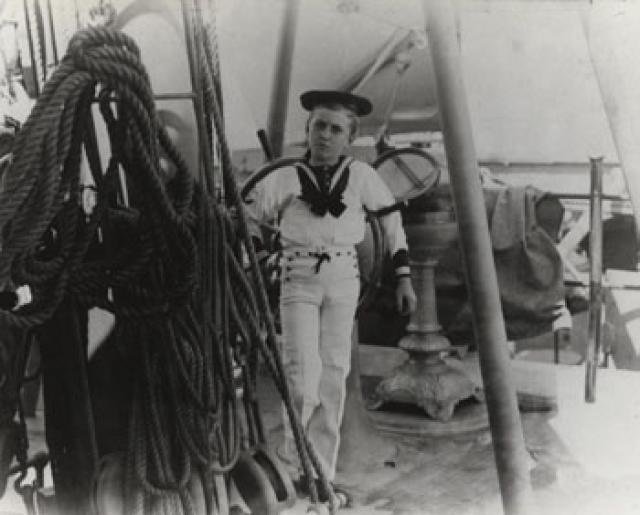
Royal Ison Ingersoll
 USA
USA- Early Life and Naval Education
- Service During World War I and Commanding Hydrographic Vessel
- Command of Hydrographic Vessel and Staff Positions
- Command of Battleships and Planning Operations
- Commander of the Atlantic Fleet and Submarine Warfare
- Planning and Execution of Operation Torch
- Direct Control of Anti-Submarine Warfare
- Innovation in Anti-Submarine Warfare
- Successes of Convoy Carrier Groups
- Operation Torch
- Retirement and Legacy
Early Life and Naval Education
Royal Ingersoll was born in Washington, D.C. in 1883, the son of a rear admiral. This influence likely played a significant role in his decision to pursue a career in the Navy, which he did at the turn of the 20th century by enrolling in the Naval Academy.
Service During World War I and Commanding Hydrographic Vessel
After graduating from the Naval Academy in 1905, Ingersoll served as a junior lieutenant aboard the battleship Connecticut, where he embarked on his first global circumnavigation. In 1911, he entered the Naval War College, where he specialized in naval warfare and English. Following his graduation, he became a flag officer for the commander of the Asiatic Fleet on the Saratoga and Cincinnati. During World War I, Ingersoll served in the Office of the Chief of Naval Operations and as an assistant commander on the battleships Connecticut and Arizona.
Command of Hydrographic Vessel and Staff Positions
In 1924, Ingersoll was appointed commander of the hydrographic vessel Nocomis. After completing a specialized course at the Naval Academy, he joined the Navy's General Staff. His expertise was recognized, and he soon became an assistant chief of staff under Admiral Pratt, who oversaw the actions of the battle fleet.
Command of Battleships and Planning Operations
In the early 1930s, Ingersoll returned to active duty, commanding the Augusta and later the San Francisco. However, his exceptional abilities earned him a return to staff duty as chief of the War Plans Division in 1935. Three years later, he was given command of the 6th Cruiser Division.
Commander of the Atlantic Fleet and Submarine Warfare
On January 1, 1942, Ingersoll succeeded Ernest King as commander of the U.S. Navy's Atlantic Fleet. He was also promoted to vice admiral. As the Atlantic Fleet commander, Ingersoll played a crucial role in developing anti-submarine warfare tactics and strategies. He issued operational orders and devised routing schedules for escort groups departing from the United States.
Planning and Execution of Operation Torch
In preparation for the Allied invasion of North Africa (Operation Torch), Admiral King entrusted Ingersoll with planning the naval aspects of the operation. Besides organizing the landing force, Ingersoll commanded the naval forces protecting Operation Torch and escorting Atlantic convoys between the U.S. and North Africa.
Direct Control of Anti-Submarine Warfare
Until the creation of the 10th Fleet in May 1943, Ingersoll—now holding the rank of admiral since July 1, 1942—exercised direct control over anti-submarine warfare. His command vessel, the Vixen, allowed him to monitor the situation from various American ports and bases. Ingersoll enthusiastically organized convoy carrier groups, personally instructing their commanders. His efforts yielded impressive results, as his aircraft groups achieved notable victories against German submarines in the Central Atlantic by mid-1943.
Innovation in Anti-Submarine Warfare
In May 1943, German Admiral Karl Dönitz ordered the "Truce" group of 17 submarines to establish a line of defense across the 43rd meridian. This tactic posed a significant threat to Allied convoys. However, Ingersoll had anticipated the possibility of such a barrier and had prepared countermeasures.
Ingersoll devised a plan involving the use of new convoy carriers that would provide close air support. He empowered the commanders of these carrier groups to pursue submarines and engage in direct protection of other convoys if necessary. This innovative tactic proved highly effective.
Successes of Convoy Carrier Groups
In the following three months, search and strike groups led by the convoy carriers Bogue, Card, Santee, and Core sank numerous German submarines. Bogue's pilots opened the offensive by sinking U-217, the large supply submarine U-118, and damaging several others from the Truce group. The escort carriers Core and Santee destroyed four more Truce submarines using newly developed FIDO anti-submarine torpedoes.
In less than three months, Ingersoll's carrier groups had sunk 15 German submarines, including eight supply boats, for the loss of only three aircraft. The Truce group managed to sink just one vessel from the Central Atlantic convoys during this period.
Operation Torch
Ingersoll's effective anti-submarine operations ensured the success of Operation Torch, a critical Allied victory that established a foothold in North Africa. His leadership and innovative tactics played a pivotal role in the outcome of the war.
Retirement and Legacy
After the war, Ingersoll retired from the Navy in 1947 with the rank of admiral. He passed away in 1958, leaving behind a legacy of exceptional service and contribution to the U.S. Navy.


