Rudolf Frants Hess
 Germany
Rudolf Franz Hess
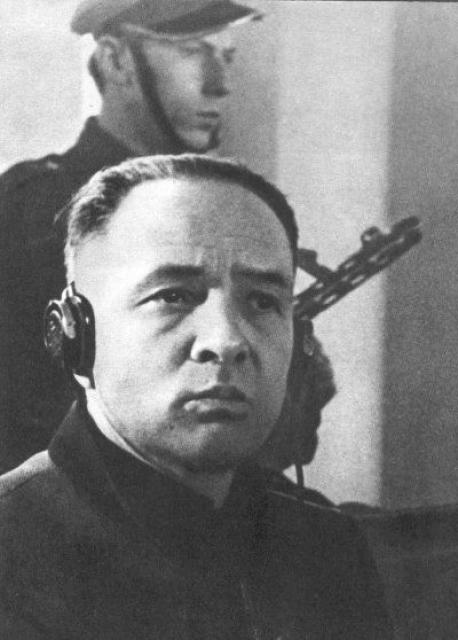
Rudolf Franz Hess was born in Baden-Baden into a Catholic family. After moving to Mannheim, he attended the oldest gymnasium in the city, Karl-Friedrich Gymnasium. His father wanted him to become a Catholic priest. After his father's death, Rudolf Hess continued his education and volunteered for the fronts of World War I on August 1, 1916. He served in the reserve squadron of the 2nd Baden Dragoon Regiment, fighting on the Iraqi and Palestinian fronts against the English army as part of the Turkish army. He was wounded multiple times and was awarded the Iron Cross 1st and 2nd class for his bravery in 1917. In 1919, he joined the Volunteer Corps Rossbach and fought against the communists in the Baltics, Ruhr, and Upper Silesia. On October 22, 1922, he joined the Nazi Party (membership number 3240). On May 26, 1923, he participated in the murder of school teacher Walter Kadow together with Martin Bormann, who they believed had betrayed Albert Leo Schlageter, a fighter against the French occupation of the Ruhr, to the French authorities. Hess and his accomplices first beat the teacher and then shot him. He was found guilty during the trial and sentenced to 10 years in prison on March 15, 1924. After the Nazi Party was banned, he automatically ceased to be a member and did not join it again. After serving four years, Hess was released on amnesty for political prisoners. Following his release, he worked in agriculture and was a member of the nationalist youth organization Artamanen. It was during this time that Hess met Heinrich Himmler. In 1929, he married Hedwig Henzel, who later gave birth to five children. After the Nazi Party came to power on September 20, 1933, Hess joined the SS (membership number 193 616) and transferred to the "Death's Head" SS unit in Dachau on December 1, 1934. He served as a block leader, reporting officer, and head of the report department in Dachau. On May 4, 1938, he was transferred to the Sachsenhausen concentration camp as the adjutant to the commandant, and from September 21, 1939, he became the commander of the camp guard. On May 4, 1940, he was appointed commandant of the newly built Auschwitz concentration camp. Along with his deputy, Karl Fritzsch, he conducted experiments on prisoners using the gas "Cyclone B". On July 27, 1941, during an inspection trip to Auschwitz, Reichsführer SS Heinrich Himmler ordered the camp to be significantly expanded. Auschwitz subsequently became the largest of the Nazi concentration camps. According to Hess's own testimony, approximately 2.5 million people were exterminated in the camp during his tenure. On November 9, 1943, he was transferred to the Inspectorate of Concentration Camps of the SS Economic and Administrative Main Office, where he headed the DI (Central Administration of Management Group "D"). He was appointed Inspector of Concentration Camps and introduced the use of "Cyclone B" gas for the extermination of prisoners in most of the camps, as was done in Auschwitz. In 1945, he was appointed Deputy Chief Inspector of the Concentration Camps by Richard Glücks. In May 1945, he fled and hid under the name "Boatswain Fritz Lang" in Schleswig-Holstein. On March 11, 1946, he was arrested by the British military police on a farm near Flensburg. He testified as a witness at the International Nuremberg Trials of Major War Criminals and also at the American Military Tribunal for the case of the SS Economic and Administrative Main Office. On May 23, 1946, he was extradited to the Polish authorities. The trial of Hess took place in Warsaw from March 11 to March 29, 1947. The Polish Supreme National Tribunal sentenced him to death by hanging on April 2, 1947. The gallows on which Hess was hanged were erected next to the crematorium of Auschwitz I in Oswiecim. French writer Robert Merle tells the story of a certain Rudolf Lang, the chief, founder, and commandant of the Auschwitz-Birkenau death camp, in his novel "Death is My Trade" (1952). The literary character Rudolf Lang closely corresponds to his real-life counterpart Rudolf Hess. The biography of the fictional character Lang also bears many similarities to the biography of Hess. In 1977, a film about him titled "A German Life" (Aus einem deutschen Leben) was made by the Germans. Primo Levi wrote the preface to the Italian edition of Hess's autobiography (1985).