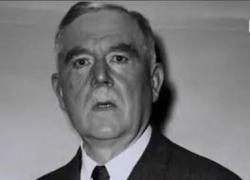
Albert Pierrepoint
 Great Britain
Biography of Albert Pierrepoint
Albert Pierrepoint, a renowned British executioner, was born in Clayton, West Yorkshire. He lived in various cities throughout his life, including Bradford, Lincoln, Oldham, and the seaside resort of Southport. Albert was the middle child in the family of Henry and Mary Pierrepoint. His father and uncle's profession had a significant influence on the young Albert. At the age of eleven, he wrote in a school essay titled "When I Grow Up..." the following lines: "When I finish school, I would like to become a state executioner."

When Henry Pierrepoint retired from his position as an executioner, the family moved to Huddersfield. However, Albert always spent his school holidays at his uncle and aunt's house in Clayton. While his uncle, Tom Pierrepoint, was away on business, Albert's aunt allowed him to read his uncle's diary, which contained records of various executions.

At the age of twelve, Pierrepoint started working at Marlborough Mills in Failsworth and earned 6 shillings per week. When his father passed away in 1922, Albert took over all his affairs and papers, which he carefully studied. By the late 1920s, he changed jobs and became a wholesale delivery driver, supplying goods ordered through a traveling salesman to a grocery store. In 1930, Pierrepoint learned to drive a car to work as a delivery driver, which significantly increased his income to £2 25 shillings per week. However, during this time, he never abandoned his desire to continue the family tradition. On April 19, 1931, Pierrepoint wrote a formal letter to the Prison Commission offering his services as his uncle Tom Pierrepoint's assistant, as the second executioner was planning to retire. Several days later, he received a disappointing response stating that there were no vacancies at the moment.

The long-awaited invitation for an interview came in the form of an official envelope from Pentonville Prison in Manchester in the autumn of 1931. Albert's mother had seen many similar envelopes when her husband, Henry, served as an executioner and was not pleased that her son had chosen the same profession. The interview was successful, and after weeks of training, Albert Pierrepoint's name appeared on the list of assistant executioners at Pentonville Prison on September 26, 1932. At that time, the assistant's salary was £1 11 shillings per execution, plus an additional payment two weeks later if the conduct was satisfactory. Executioners and their assistants had to be extremely cautious, behave appropriately, and, most importantly, avoid contact with the press.
Although there were several executions in the summer and autumn of 1932, Albert Pierrepoint's debut as the lead executioner took place on December 29. On that day, Patrick McDermott was supposed to be hanged, and Albert assisted his uncle Thomas, the chief executioner, in Mountjoy Prison in Dublin. Until 1944, Pierrepoint mainly served as an assistant, although his first execution as the lead executioner took place on October 17, 1941, at Pentonville Prison. During these years, Albert entered into a relationship with Annie Fletcher, who owned a confectionery and two grocery stores, where Albert also worked. They got married on August 29, 1943, and moved to a new home in Newton Heath, Manchester. The family never discussed Albert's other job until he had to leave for Gibraltar in January 1944 to perform a double execution. Annie knew a lot about her husband's work but never initiated conversations on this topic. However, now she was looking forward to his return to discuss it. As it turned out, there was much she didn't know. Annie was unaware that the night before an execution, Albert would study the case of the condemned person he was about to hang, learning their height, weight, and using this information to calculate the length of the rope to the nearest millimeter. He would observe them through a peephole and often sleep in the adjacent cell with the prisoner. In the morning, the executioner would enter the condemned person's cell, gently touch their shoulder, and quietly say, "Everything will be alright, follow me." He would then lead them to the adjacent room, where everything was ready for the execution. Within seconds, he would remove the lifeless body from the noose. Like many other executioners, Pierrepoint aimed to minimize the time of the execution to inflict as little mental and physical trauma as possible on the condemned person. He claimed to have reduced the time from awakening the prisoner to their death to 10 seconds, with death occurring instantly due to a broken neck rather than strangulation, as many believed. This is why he meticulously gathered data about the prisoner beforehand.
After World War II, the British occupation authorities surveyed the staff of a concentration camp and conducted a series of trials, resulting in 11 death sentences in November 1945. Pierrepoint was assigned to carry out these executions, and on December 11, he flew to Germany for the first time. In addition to the 11 condemned individuals, he was also tasked with executing two German nationals who had been found guilty of murdering a British pilot in the Netherlands in March of the same year. The next four years of Pierrepoint's career promised to be eventful as he was scheduled to visit Germany and Austria 25 times to carry out sentences for 200 war criminals. Not surprisingly, these events received significant media coverage, and Pierrepoint's persona became widely known. The press even dubbed him a war hero seeking justice for the Nazis. These executions and the media attention significantly increased the Pierrepoints' income, allowing them to leave the grocery business and purchase a pub on Manchester Road called "Help the Poor Struggler." However, they did not remain the owners for long and soon switched to the "Rose and Crown" in a village near Preston. Albert Pierrepoint retired in 1956 due to disagreements with the Home Office regarding his fee. The conflict began when in January 1956, Pierrepoint arrived at Manchester Prison to carry out the sentence of Thomas Bancroft, but for unknown reasons, the execution, which was already prepared, was postponed for 12 hours. Dissatisfied with the situation, Pierrepoint, who experienced such a delay for the first time, demanded a payment of £15 for his work and the inconvenience caused. However, the deputy sheriff offered him only £1 as an advance payment (in England, executioners were paid only a portion of the promised fee on the day of the execution, while in Scotland, they were paid in full). Albert turned to the Prison Commission, which did not sympathize with the well-known executioner's position and refused to participate in the investigation. Nevertheless, Pierrepoint eventually carried out the execution and later received a check for £4 from the deputy sheriff. The official version of events states that deeply offended by such treatment, Britain's chief executioner resigned. However, there is another opinion that he had decided to retire even before Bancroft's execution and had previously discussed this matter with the editor of the "Empire News and Sunday Chronicle." Pierrepoint became the only executioner in British history whose resignation prompted the Home Office to write to him and ask him to reconsider his decision. But the executioner was inflexible and, after retiring, continued his business with his wife. Many years later, they moved to Southport, where Annie passed away. Albert Pierrepoint himself died on July 10, 1992, in a nursing home where he spent the last four years of his life.