Ruslan Stratonovich
 Russia
Some of Ruslan Stratonovich’s most influential ideas began with a practical problem: how can a system be understood when its measurements are blurred by noise? A Soviet and Russian physicist and probability theorist, he developed mathematical tools for tracking hidden processes, interpreting random fluctuations and making decisions from incomplete information. The stochastic integral that bears his name became a widely used alternative to Itô’s formulation, especially in models of physical systems.
A Remarkable Student
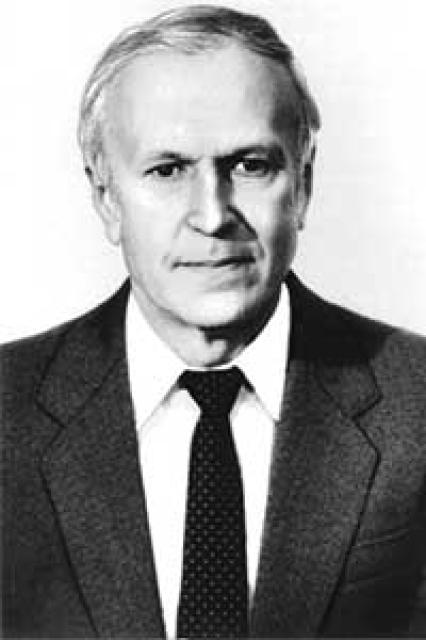
Stratonovich was born in Moscow on May 31, 1930. He completed his school examinations early as an external student, earning a gold medal, and entered the physics faculty of Moscow State University in 1947. He graduated in 1953 and remained at the university, where his early research examined random points and the noise produced by streams of electrons.
He earned a candidate degree in physics and mathematics in 1956, followed by a doctorate in 1964. His doctoral work on conditional Markov processes connected probability theory to optimal control: how to choose the best action when a system’s true state is not directly visible. In 1969, he became a professor at Moscow State University, where he taught and researched for the rest of his life.
Making Sense of Randomness
Stratonovich is best known for a symmetric way of interpreting stochastic differential equations—equations that describe systems affected by continual random changes. His formulation, developed in the early 1960s and first presented as a “symmetrization” calculus, offered an alternative to the Itô integral. It often fits naturally with physical models in which noise arises from many small, rapidly changing influences.
His work on conditional Markov processes led to new approaches to nonlinear filtering. Filtering is the task of estimating a hidden signal or state from observations mixed with noise; it matters in everything from radio engineering to navigation and control. Stratonovich’s mathematical framework helped researchers analyze oscillating systems under noise and design devices that could make useful estimates when information was incomplete.
These ideas traveled well beyond theoretical physics. Moscow State University records their application in statistical radio physics, information systems and aerospace engineering, as well as in air- and missile-defense systems. His studies of “the value of information” also linked information theory with statistical decision-making and optimal control, offering a way to ask how much a new measurement or signal is worth before choosing an action.
Beyond Probability Theory
Stratonovich worked across statistical physics, information theory, nonlinear thermodynamics, quantum measurement and chemical kinetics. His books included “Selected Topics in the Theory of Fluctuations in Radio Engineering,” “Information Theory” and “Nonlinear Nonequilibrium Thermodynamics.” Colleagues later counted seven monographs and about 180 research papers, most of them written by Stratonovich alone.
His work received the Lomonosov Prize from Moscow State University in 1984, the USSR State Prize in 1988 and the Russian Federation State Prize in 1996. He was named an Honored Professor of Moscow State University in 1994.
A Teacher’s Life
Stratonovich held no administrative posts and remained in the same university faculty for his entire career, working at the boundary of theory and experiment. Colleagues remembered not just an exacting scientist but a warm and curious person. He loved Russian poetry, wrote lyrics, studied painting, read fiction in four foreign languages and enjoyed figure skating, tennis and cycling. They recalled that he sometimes rode his bicycle to work.
He died in Moscow on January 13, 1997, aged 66. The Stratonovich integral and the equations, filtering methods and concepts of information value associated with his name remain part of the international scientific vocabulary. His legacy is the rare combination of mathematical depth and practical reach: tools designed to understand randomness that became useful across physics, engineering and the study of information.