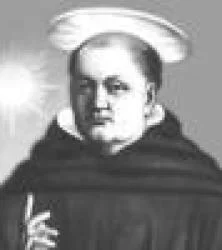
Saint Dominic
Dominic de Guzmán founded an order built around a simple but demanding idea: learned preaching should be joined to a life of poverty. The community he organized became the Order of Preachers, widely known as the Dominicans, and spread across medieval Europe. Dominic’s own work was shaped by the religious conflicts of southern France, where he tried to persuade people through argument and example.
Early Life and Education
Dominic was born around 1170 in Caleruega, in the kingdom of Castile. The son of a noble family, he received his early education from a priestly uncle and later studied theology and the liberal arts at Palencia. After his studies, he became a canon at the cathedral of Osma, where he lived under a religious rule that emphasized common life and prayer.
Around 1203, Dominic traveled with his bishop, Diego de Acebes, on a diplomatic mission. Their route through southern France brought them into contact with the Cathar movement, which church authorities opposed as heretical. Dominic saw the need for clergy who could meet its appeal through direct, informed preaching and a visible life of simplicity.
Preaching in Languedoc
Dominic spent years in Languedoc, preaching and debating. He and his companions traveled without the wealth and display that had damaged the Church’s credibility with some audiences. In 1206 he helped establish a community of women at Prouille, which offered a religious home to women who had left Cathar communities.
This preaching took place during the violent Albigensian Crusade, launched by Catholic rulers against the Cathars and their supporters. Dominic was associated with the campaign’s religious mission, but he was not a military commander. His own method was to preach and persuade. Later retellings sometimes make him a founder of the Inquisition, but that claim is inaccurate: the inquisitorial system developed after his lifetime, and his documented work centered on preaching and organizing a religious community.
Founding the Order of Preachers
By 1215 Dominic had gathered a group of companions in Toulouse. They combined communal religious life with study and preaching, an approach suited to an urban world where universities and public debate were growing. Dominic sought formal approval for the community from Pope Innocent III; it was his successor, Honorius III, who confirmed the Order of Preachers in 1216 and recognized its mission in 1217.
Dominic then sent the friars to establish communities in major centers such as Paris, Bologna, Rome and Spain. The order’s emphasis on education helped it grow rapidly. Its members became known as Dominicans, and later generations produced influential theologians, including Albertus Magnus and Thomas Aquinas.
Final Years and Legacy
Dominic continued to travel and preach, helping organize the new order through its early chapters. He died in Bologna on August 6, 1221, worn out by years of work. Pope Gregory IX canonized him in 1234.
His legacy rests on the institution he founded and the model of religious life he promoted: rigorous study, communal discipline and preaching supported by personal simplicity. The Dominicans became a lasting force in Christian education and public religious life, carrying Dominic’s vision far beyond the conflicts that first shaped it.