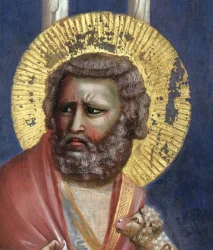
Saint Spyridon
Saint Spyridon was a fourth-century bishop of Trimythous, a town on the island of Cyprus, and one of the island’s most venerated Christian figures. Later tradition remembers him as a humble shepherd who continued his simple way of life after becoming a bishop. Church historians also place him at the First Council of Nicaea in 325, where Christian leaders gathered to address disputes over doctrine. His life became the subject of a rich cycle of stories that blend historical memory with accounts of miracles.
From shepherd to bishop
Spyridon is traditionally said to have been born around 270 on Cyprus. Little can be established about his early life with certainty. The fifth-century historian Socrates Scholasticus records the tradition that Spyridon had been a shepherd and that his reputation for piety led to his appointment as bishop of Trimythous. He also writes that Spyridon continued tending his flock even after becoming a bishop, an image that captured the saint’s enduring association with humility and practical care.
Church tradition says that Spyridon was married and had a daughter. After his wife’s death, he devoted himself more fully to the Church, and he was eventually chosen to lead the Christian community in Trimythous. The surviving historical evidence for his life is limited, and many personal details come from accounts written generations later. Yet the fact that early church historians remembered him as a Cypriot bishop and participant in the Council of Nicaea helped preserve his place in the history of early Christianity.
The Council of Nicaea
In 325, Emperor Constantine convened bishops from across the Roman Empire at Nicaea, in present-day İznik, Turkey. The council addressed the controversy over the relationship between God the Father and Christ, and produced the creed that became central to Christian orthodoxy. Later historians, including Socrates and Sozomen, name Spyridon among the bishops who attended.
Spyridon was not remembered primarily as a sophisticated theologian. Later accounts instead portray him as a direct and persuasive speaker whose faith was rooted in simple conviction. One famous story says that he used a brick to explain the Christian doctrine of the Trinity: when he held it, fire rose from it, water flowed down, and earth remained in his hand. This episode is part of the saint’s hagiographic tradition rather than independently verified history, but it reflects how later Christians understood his plain style of teaching.
Stories of generosity and miracles
The early church histories also preserve stories about Spyridon’s compassion. Socrates recounts an episode in which thieves became mysteriously trapped while trying to steal sheep. When Spyridon found them in the morning, he released them, urged them to earn their living honestly, and gave them an animal so they would not leave empty-handed. The story presents him as a pastor concerned with correcting wrongdoing while still showing mercy.
Many additional miracles became associated with his name, including healings and interventions during crises. These accounts formed an important part of his veneration in the Eastern Christian world. They should be understood as expressions of religious memory and devotion, not as details that can be confirmed by ordinary historical evidence.
Spyridon is traditionally said to have died in 348. His cult spread well beyond Cyprus, and his relics are now kept in a church dedicated to him on the Greek island of Corfu, where he is regarded as the island’s patron saint. His feast day is observed on December 12 in the Eastern Orthodox Church.
Legacy
Spyridon’s lasting reputation rests on the combination of episcopal authority and an image of everyday humility. The historical record places him among the bishops of Cyprus and associates him with the formative Council of Nicaea. The stories told about him emphasize hospitality, charity, and a faith expressed through action rather than status.
For centuries, Christians have turned to Spyridon as a protector and wonderworker. His veneration connects the island where he served with communities across the Orthodox world, especially Corfu, where his relics remain a focus of devotion. Although much of the familiar narrative belongs to later hagiography, the traditions preserve a powerful portrait of the shepherd-bishop: a leader remembered for spiritual conviction and care for ordinary people.