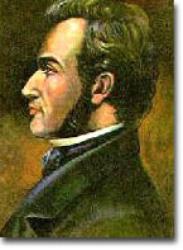
Samuel Pepys
 Great Britain
Biography of Samuel Pepys
Samuel Pepys was an English naval official and the author of a famous diary detailing the everyday lives of Londoners during the Restoration period. He was born the son of a London tailor and attended St. Paul's School before going on to Magdalene College, Cambridge. In 1655, he married Elizabeth de St. Michel, a fifteen-year-old daughter of a impoverished French Huguenot refugee (she passed away in 1669). The family began their life in poverty, but Pepys found employment in the household of his distant relative, the influential military and political figure Sir Edward Montagu (later Earl of Sandwich), who played a significant role in his subsequent career.
Early Career and Royal Service
At the beginning of Charles II's reign, Pepys was appointed as a clerk in the Royal Navy in 1660. In 1665, he became the Chief Clerk of the Victualling Office, and in 1672, he was appointed as the Secretary to the Admiralty. In 1665, Pepys also became a member of the Royal Society, serving as its president from 1684 to 1686. He was elected to the British Parliament and re-elected in 1679, but was dismissed and briefly imprisoned in the Tower of London due to accusations of involvement in a conspiracy, brought forth by his enemies and rivals.
Later Life and Legacy
In 1683, Pepys was sent on a mission to Tangier and, upon returning, became the Secretary of State for Naval Affairs. He actively contributed to the modernization of the navy during the reign of both Charles II and James II. In 1689, after the removal of King James and the ascension of William of Orange, Pepys lost the parliamentary election and was forced to step down from his high position. He was briefly imprisoned in 1689 and 1690 on suspicion of Jacobite sympathies. Following this, Pepys retired from public life and in 1700, he left London to live on his estate, where he passed away a few years later.
Pepys was friends with Isaac Newton and Robert Boyle, as well as John Dryden and Christopher Wren. He enjoyed playing music, painting, and writing poetry. However, his most significant work was his diary, which he maintained from 1660 to 1669. In it, he documented not only major events such as the Great Plague of London in 1665 and the Great Fire of London in 1666, but also details of his own daily life, including his meals, romantic relationships, and more. Pepys stopped writing in his diary due to vision problems and refused to dictate it to someone else. The diary, which was encrypted using Thomas Shelton's system, remained untouched in Magdalene College's library until the early 19th century, when it was deciphered by textual scholar John Smith. It was first published in 1825 and has since been reprinted in both full and abridged versions (known as the "Great" and "Little" Pepys). The diary has been translated into numerous languages and is regarded as an invaluable historical source and an entertaining leisure read, which Pepys himself loved, as he was also an avid bibliophile (his library was also bequeathed to Magdalene College).
In the 20th century, Pepys' personal life, his relationships with his wife, and his extramarital escapades, which are also vividly portrayed in the diary, became the subject of several novels written from both the perspective of the family patriarch and his young wife. In 2003, a multi-part television series titled "The Private Life of Samuel Pepys" was aired in the UK, starring English actor Steve Coogan in the titular role and French actress Ludivine Sagnier as his wife.