Saxo Grammaticus
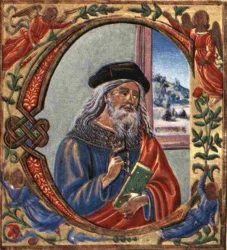
Saxo Grammaticus was a Danish cleric and historian whose *Gesta Danorum* became one of the most important works of medieval Scandinavian literature. Written in Latin around the turn of the thirteenth century, the sweeping history carried Danish stories from legendary origins to the political world of Saxo’s own time. Its vivid account of the prince Amleth also helped inspire Shakespeare’s *Hamlet*.
A Life in Medieval Denmark
Very little can be established about Saxo’s personal life. He was active in the late twelfth and early thirteenth centuries and is generally thought to have come from Zealand, the Danish island that includes Copenhagen. His name and epithet are Latinized; “Grammaticus” reflects his reputation for learning and eloquent Latin.
Saxo was closely associated with Archbishop Absalon of Lund, one of the most influential religious and political leaders in Denmark. In the preface to his history, Saxo says Absalon charged him with writing about the Danes and their deeds. He appears to have belonged to the archbishop’s circle, perhaps as a cleric or secretary, though the details of his position remain uncertain.
Writing *Gesta Danorum*
Saxo’s great work, *Gesta Danorum* (“The Deeds of the Danes”), is an ambitious history in sixteen books. It begins with legendary rulers and heroic tales, then moves through the Christianization of Denmark and the reigns of historical kings, eventually reaching events close to Saxo’s own day. He wrote in a polished Latin style shaped by classical authors, especially Virgil and other Roman historians.
The work is both a record of medieval Danish culture and a political narrative. It celebrates Denmark’s rulers and presents the kingdom as a land with an ancient, distinguished past. The first books draw heavily on legend and oral tradition, so their stories cannot be read as straightforward factual accounts. Later sections, particularly those closer to Saxo’s lifetime, offer valuable information about Danish politics, warfare, and church life, while still reflecting the author’s perspective and loyalties.
Among the most memorable episodes is the story of Amleth, a prince who feigns madness while plotting revenge against his uncle. Saxo’s version is the earliest surviving detailed account of the legend and became one of the sources used by Shakespeare for *Hamlet*. The tale gave a medieval Danish chronicle an unexpected afterlife on the world stage.
Influence and Legacy
Saxo likely completed the work after Absalon’s death in 1201 and dedicated it to Anders Sunesen, Absalon’s successor as archbishop. The full text survived through a difficult manuscript tradition. Its first printed edition appeared in Paris in 1514, prepared by the Danish scholar Christiern Pedersen, helping preserve a work that had otherwise circulated in limited copies.
Today, *Gesta Danorum* remains indispensable to the study of medieval Denmark, though historians read it critically, distinguishing its literary and legendary material from the evidence it offers about Saxo’s own era. It shaped later ideas of Danish history and preserved stories that might otherwise have been lost. Through its blend of national memory, classical learning, and dramatic storytelling, Saxo fashioned a work that still connects the medieval North to modern readers.