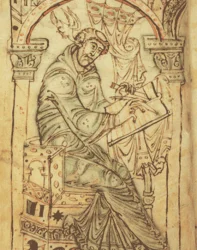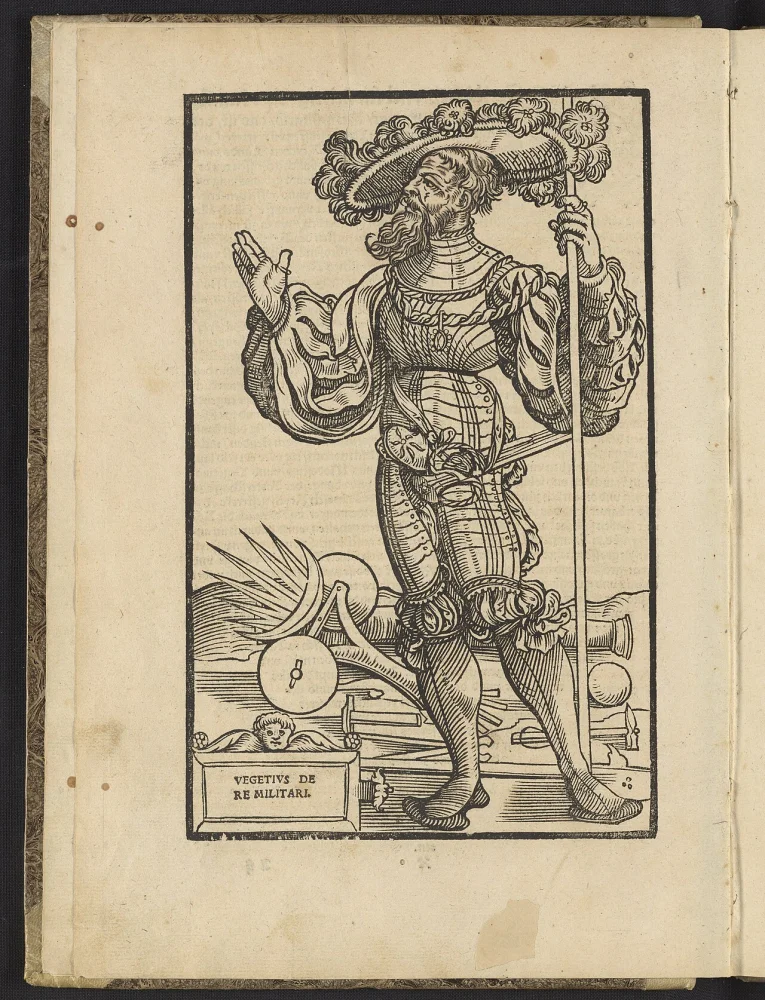
Vegetius
Vegetius was a late Roman writer whose handbook on military affairs became one of the most influential guides to warfare in medieval Europe. Writing during a period when Roman power in the West faced mounting pressures, he urged emperors to restore discipline, training, and the traditional strengths of the Roman army. His work outlived the institutions it sought to reform and continued to shape military thought for centuries.
A writer whose life remains obscure
Known in Latin as Vegetius Renatus, he left few reliable details about his personal life. Scholars generally place his writing in the late fourth or early fifth century, though the exact date and the identity of the emperor to whom he addressed his work remain uncertain. The available evidence suggests that he was a Christian and a well-connected civilian official, but it is unclear whether he had served as a soldier himself.
The lack of biographical information has not diminished his importance. His works offer a rare window into how a late Roman intellectual understood the army, its history, and the challenges facing the empire.
“Epitoma rei militaris”
Vegetius’s best-known book is the “Epitoma rei militaris,” also called “De re militari” (“On Military Affairs”). It is a practical and historical account of military organization, recruitment, training, discipline, strategy, and siegecraft. Rather than celebrate the army as it existed in his own time, Vegetius compared it with older Roman practice and argued that careful preparation had once made Rome powerful.
He emphasized selecting recruits for physical fitness and character, drilling them consistently, and maintaining discipline. He advocated restoring the traditional legion and warned against depending too heavily on hired foreign troops. His text was not a neutral snapshot of every Roman military practice; it was a reform-minded proposal that looked back to an idealized earlier army as a solution to contemporary problems.
The book’s famous maxim is often rendered, “If you want peace, prepare for war.” The phrase captures the practical tone of Vegetius’s work: military strength, in his view, depended less on improvisation than on preparation long before a crisis arrived.
Beyond the battlefield
Vegetius also wrote “Digesta artis mulomedicinae,” a substantial treatise on veterinary medicine, especially the care and treatment of horses and mules. The work reflects the importance of animal health to Roman transport, agriculture, and military logistics, and it suggests that his interests extended well beyond battlefield tactics.
A long afterlife
“De re militari” circulated widely in the Middle Ages. It was copied, translated, and consulted by rulers and military thinkers who sought a systematic guide to armies and warfare. For many centuries in western Europe, it served as one of the most accessible surviving accounts of ancient military organization.
Vegetius’s legacy rests on the unusual endurance of his ideas. He wrote for an emperor facing a changing world, but his emphasis on training, discipline, and preparation remained relevant long after Rome’s western empire had disappeared.