Sergey Diagelev
 Russia
- Biography of Sergei Diaghilev
- Early Life and Career
- The Russian Seasons
- An Entrepreneur and Artistic Visionary
- A Visionary with a Mission
- The Birth of Russian Ballet
- The Concept of Ballet
Biography of Sergei Diaghilev
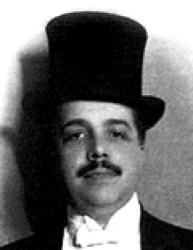
Sergei Diaghilev was a Russian patron, producer, and the founder of the Ballets Russes. He played a crucial role in popularizing Russian culture in the West. Diaghilev, who referred to himself as a "patron of European style," opened a "cultural window to Europe" for Russia in the early 20th century. He gave the world an understanding of the global and enduring value of Russian culture, and deserved to have the Russian culture of the current century rise under the motto "The Age of Diaghilev."
Early Life and Career
Sergei Pavlovich Diaghilev (1872-1929) was a theater and art figure, publisher, and critic. He was born in Perm, Russia and moved to St. Petersburg in 1890. Diaghilev graduated from the Law Faculty of St. Petersburg University in 1896, while also attending singing classes as a free listener at the St. Petersburg Conservatory and taking composition lessons. From 1899 to 1901, he worked as a special assignments official at the Directorate of Imperial Theaters. In 1898, he co-founded the journal "World of Art" and became its chief editor. In 1900, he was one of the founders of the artistic society "World of Art." He organized several art exhibitions in St. Petersburg, which focused on strict conceptual selection of exhibits and high exhibition standards. Diaghilev's apartments in St. Petersburg became centers of artistic life in the late 19th and early 20th centuries.
The Russian Seasons
Starting from 1906, Diaghilev concentrated all his energy and extraordinary organizational skills on promoting Russian art in Western Europe. In 1906, he showcased collections of icons and paintings from the 18th to the early 19th centuries, as well as works by artists from the "World of Art" group, at the "Russian Art Exhibition" in Paris. In 1907, he organized five "Historical Russian Concerts" in Paris, presenting Russian music from Mikhail Glinka to Alexander Skryabin. In 1908, he staged Modest Mussorgsky's opera "Boris Godunov" at the Grand Opera in Paris, featuring Feodor Chaliapin. In 1909, he organized the first of the regular "Russian Seasons," which prominently featured ballet (later known as "Serge Diaghilev's Ballets Russes" from 1913-1929). Diaghilev brought leading dancers such as Michel Fokine, Tamara Karsavina, Vaslav Nijinsky, and choreographers like Leon Bakst, Alexandre Benois, Ivan Bilibin, Nicholas Roerich, and Mstislav Dobuzhinsky to participate in the "Russian Seasons." His avant-garde enterprise became an integral part of European cultural life in the early 1900s, influencing all aspects of art. In 1990, the Sergei Diaghilev Center for International Arts was established in St. Petersburg.
An Entrepreneur and Artistic Visionary
Diaghilev's work was not simply about running a theater, as provincial entrepreneurs would describe their business. It was much more than that - an endeavor that involved almost the entire continent of Europe (and, in terms of cultural influence, the entire world). He defied the conventional norms of the 19th century by combining the "low" practice of artistic entrepreneurship with high art. Diaghilev's practical acumen, combined with his artistic intuition, allowed him to introduce Europe and America to the achievements of Russian culture in painting, opera, and ballet since 1906. Through Russian culture, which expressed the greatness and diversity of Russia's spiritual life, Europe looked at Russia with new eyes in the early 20th century. Diaghilev played a colossal role in this transformation. He was a man of ideas, not money, and he was a true artistic leader - one of the most prominent leaders of artistic avant-garde of the 20th century.
A Visionary with a Mission
Diaghilev's passion initially lay in Russian opera, rather than the traditional Russian ballet. He idolized Mikhail Glinka from a young age and dreamed of becoming an opera singer. Although he never fulfilled that dream, he became a propagandist for Russian opera, first as a critic and publicist, and later as an impresario, organizing international tours. Diaghilev considered it his mission to introduce Europe to Russian music, particularly opera. In 1907, the "Russian Historical Concerts" were held in Paris, showcasing the works of Glinka, Borodin, Mussorgsky, Rimsky-Korsakov, and other Russian composers. The concerts aimed to overwhelm the audience with the artistic diversity and richness of Russian music, while also demonstrating the internal unity and integrity of Russian musical culture. Diaghilev believed that there was a creative connection between opera and instrumental music, Russian melos and Russian symphonism, and he wanted to showcase this connection through the participation of renowned performers such as Feodor Chaliapin and Sergei Rachmaninoff.
The Birth of Russian Ballet
Despite his initial focus on opera, Diaghilev's most significant achievement came in the form of Russian ballet. In the early years of the "Russian Seasons," he built almost the entire repertoire of the "new Russian ballet," which received recognition and acclaim from all the leading figures of the ballet world in the 1910s and 1920s. However, in the first years, until the outbreak of World War I, Diaghilev never abandoned his hopes of showcasing Russian operas to Europe. Although it was technically much more challenging than staging a performance composed of short one-act ballets, Diaghilev's strong will, which allowed him to overcome unfavorable circumstances, triumphed once again. In 1913, during the London tour, he presented "Boris Godunov," "Khovanshchina," and "The Maid of Pskov." In 1914, he showcased "The Golden Cockerel" (transformed into a ballet) and "Prince Igor." It is worth noting that all of these operas were based on Russian historical subjects or events, reflecting Diaghilev's fascination with Russian history and the pivotal figures who shaped it. Diaghilev believed himself to be a descendant of Peter the Great, the great reformer of Russia, and he wanted to present Europe with the true - beautiful and awe-inspiring - image of Russia.
The Concept of Ballet
The concept of ballet that emerged during the "Russian Seasons" was the most intriguing aspect of Diaghilev's artistic biography. It was shaped by various influences, including the genius intuition of ballet master Michel Fokine, the conscious efforts of artist and ideologist Alexander Benois, and Diaghilev's own partly conscious and partly intuitive inclinations as a director and leader. The general artistic style of the time also played a role in this transformation. Diaghilev's concept of ballet was centered on the idea of bringing together different art forms, such as dance, music, painting, and theater, to create a total work of art. By incorporating dance into a broader artistic context, Diaghilev aimed to create a new and innovative form of ballet that would transcend the traditional boundaries of the genre.
In summary, Sergei Diaghilev was a visionary and a cultural entrepreneur who revolutionized the world of ballet and promoted Russian culture on a global scale. His artistic intuition, organizational skills, and determination allowed him to create the Ballets Russes, which became an iconic institution in the history of dance. Diaghilev's legacy continues to inspire and influence the world of dance and the arts to this day.