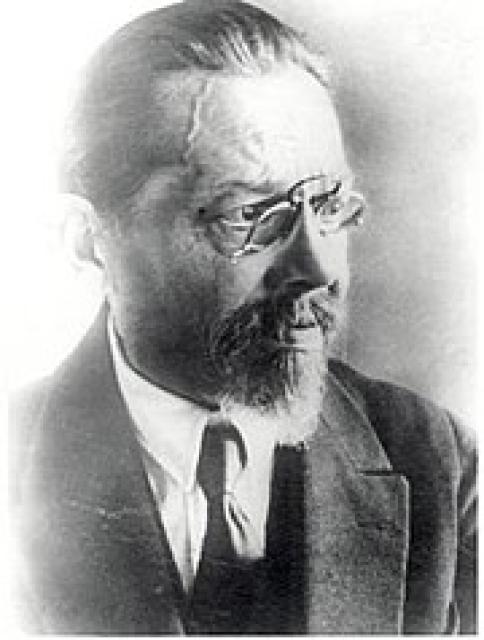
Sergey Kazakov
- Sergei Alexandrovich Kazakov: A Renowned Astronomer
- Academic Career
- Professional Achievements
- Publications and Legacy
Sergei Alexandrovich Kazakov: A Renowned Astronomer
Early Life and EducationSergei Alexandrovich Kazakov was born into a civil servant's family in Rybinsk, Russia. As a brilliant student, he earned a gold medal upon graduating from Rybinsk Classical Gymnasium in 1883. He pursued higher education at Moscow University, where he studied physics and mathematics, graduating in 1895. With a desire to pursue academia, he remained at the university to prepare for professorship.
Academic Career
Kazakov embarked on his teaching career as a private lecturer at Moscow University on February 3, 1900. To enhance his expertise, he completed an internship at the Berlin Computing Institute in 1904. Upon his return, he introduced a specialized course on "Calculations and Corrections of Planetary and Cometary Orbits," later renamed "Computational Techniques and Interpolation" in 1920. Kazakov became a senior assistant at the university's observatory on March 11, 1915, and a professor on October 1, 1918. Despite presenting his dissertation on "Orbit of Comet 1904 I" in 1917, he did not officially defend it due to the abolition of academic degrees at the time. Kazakov assumed responsibility for teaching celestial mechanics, a course previously handled by P. K. Sternberg.
Professional Achievements
Kazakov's contributions to astronomy were significant. He headed the astronomy department at Moscow University after 1920 and held several administrative positions, including serving as chairman of the astronomy department and dean of the physics and mathematics faculty for two years (1927 and 1928). His expertise lay in theoretical astronomy and astrometry, particularly in understanding the determination and correction of comet and planetary orbits. He calculated the final orbits of comets 1904 I, 1907 III, and Perrault's periodic comet 1896 VII for 1922. Kazakov also explored the problem of integrating the essential differential equations in the three-body problem of celestial mechanics. In addition, he used the meridian circle to determine star positions in the zenith zone (from 50° to 55° north declination) from 1914 to 1930.
Publications and Legacy
Kazakov authored several influential textbooks, including "Foundations of Theoretical Astronomy" (1913) and "Course in Spherical Astronomy" (1935). His works continue to be valuable resources in the field of astronomy. Kazakov's dedication to astronomical research and education left an enduring mark on the scientific community. He is remembered as a pioneer in the field and a respected mentor to generations of aspiring astronomers.


