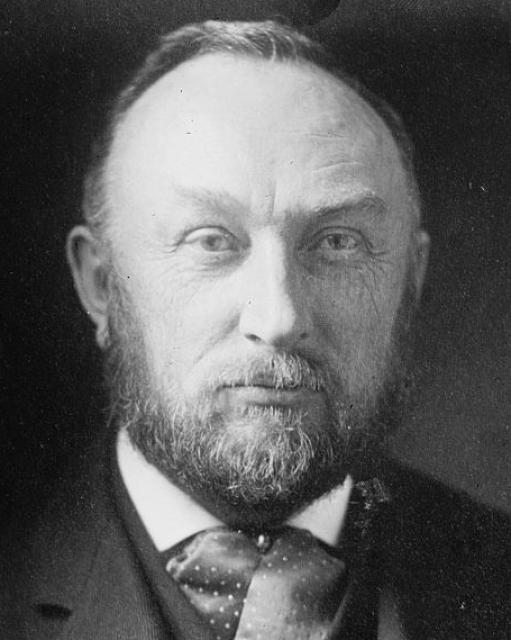
Edward Pickering
 USA
USA- Early Life and Education
- Academic Career
- Harvard University (1876-1919)
- Contributions to Astronomy
- Astrophotometry and Astroscopy
- Stellar Photography
- Stellar Spectroscopy
- Variable Stars
- Harvard Southern Station
- Honors and Legacy
Early Life and Education
Edward Charles Pickering was born on July 19, 1846, in Boston, Massachusetts. He graduated from the Lawrence Scientific School in 1865, where he later taught mathematics.
Academic Career
Massachusetts Institute of Technology (1867-1876)Pickering joined the Massachusetts Institute of Technology in 1867 as a professor of physics. During his tenure, he established the first student physics laboratory in America.
Harvard University (1876-1919)
In 1876, Pickering became a professor of astronomy and director of the Harvard College Observatory at Harvard University. He held these positions until his death in 1919.
Contributions to Astronomy
Pickering made significant contributions to astrophysics and astronomy, primarily through his use of photography and spectroscopy:
Astrophotometry and Astroscopy
Pickering developed visual photometry and invented the meridian photometer, comparing stars to the North Star using a polarizing device.
Stellar Photography
He applied photography extensively to astronomy. In 1884, he published the first catalog of 4,260 stars from the North Pole to -30°, followed by a comprehensive catalog of the entire night sky in 1913.
Stellar Spectroscopy
Pickering participated in the compilation of a catalog of stellar spectra from 1886-1889. The classification used in this catalog, known as the Harvard Classification, is still used today.
He also created the fundamental Henry Draper Catalogue (1918-1924), containing spectra of nearly 400,000 stars.
Variable Stars
Pickering classified variable stars and developed the polarizing method for determining stellar brightness, named after him.
Harvard Southern Station
In 1891, Pickering established the Harvard College Observatory Southern Station in Arequipa, Peru. Together with his brother, William Pickering, he organized systematic photography of the sky for the discovery and study of variable stars.
Honors and Legacy
Pickering was a member of various scientific academies and received numerous awards, including the Rumford Medal, two Gold Medals from the Royal Astronomical Society, and the Bruce Medal.
The American Association of Variable Star Observers was founded by Pickering. He died in Cambridge, Massachusetts, on February 3, 1919.


