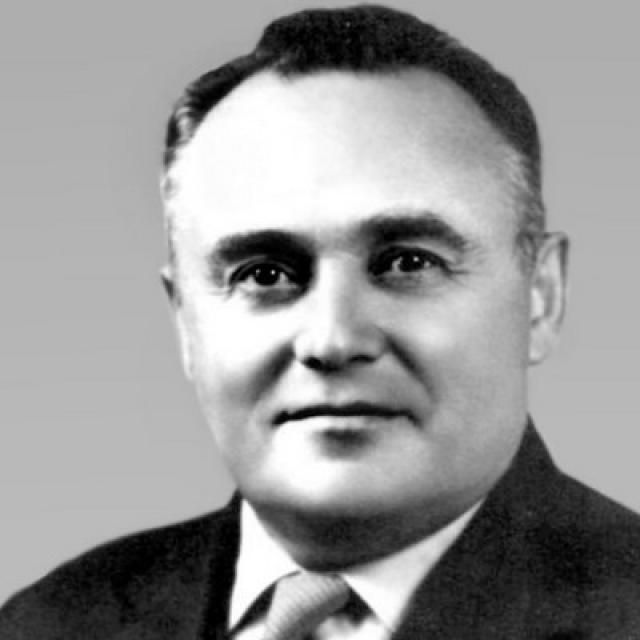
Sergey Korolev
- Childhood and Education
- Early Career in Rocketry
- Arrest and Return to Engineering
- Chief Designer and the Space Race
- Private Life and Public Identity
- Death and Legacy
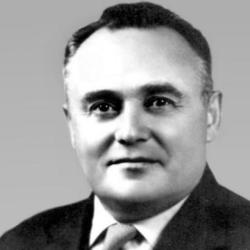
Sergei Pavlovich Korolev was the Soviet rocket engineer whose work carried the USSR from experimental rocketry into the opening triumphs of the Space Age. Known publicly during his lifetime only as the “Chief Designer,” he led the teams behind Sputnik, the first artificial satellite, and the spacecraft that took Yuri Gagarin into orbit. His rise was interrupted by arrest and years of imprisonment during Stalin’s purges, an ordeal that left a lasting mark on his health and career.
Childhood and Education
Korolev was born on January 12, 1907, in Zhytomyr, then part of the Russian Empire and now in Ukraine. His parents were teachers. After their separation, he was raised in part by his mother’s family and later by his stepfather. As a boy he became fascinated by aviation, building models and watching aircraft whenever he could.
He completed vocational schooling in Odesa and entered the Kyiv Polytechnic Institute in 1924, where he studied aviation and designed gliders. He continued his education in Moscow at the Bauman Moscow Higher Technical School, combining study with work in aviation. There he developed as both an aircraft designer and an advocate of powered flight.
Early Career in Rocketry
In the late 1920s Korolev worked on gliders and aircraft, and in 1930 he qualified as an engineer. His interests increasingly turned to rocket propulsion. In 1931 he and fellow enthusiast Friedrich Zander helped establish the Group for the Study of Reactive Motion, known by its Russian initials GIRD. The group tested liquid-fueled rockets and made rocketry a practical engineering pursuit rather than a distant speculation.
In 1933 GIRD was combined with a military research organization to form the Reaction Propulsion Scientific Research Institute. Korolev worked on rocket engines and rocket-powered aircraft, including a glider intended to take off with rocket assistance. These projects were still experimental, but they helped build the technical foundation for the launch vehicles that would later define his career.
Arrest and Return to Engineering
The purges of the late 1930s abruptly broke his progress. Korolev was arrested in June 1938 on fabricated charges of sabotage and sentenced to hard labor. He endured interrogations, prison and labor camps, including a period in the Kolyma region. His sentence was later reduced, and he was transferred to a special prison design bureau, where engineers worked under confinement. There, alongside other specialists including aircraft designer Andrei Tupolev, he contributed to aviation projects.
During the Second World War, Korolev was assigned to work on rocket-assisted aircraft and other military technology. He was released from prison in 1944, though his conviction was not formally overturned until 1957. The years of imprisonment had taken a severe toll, but he returned to design work and was soon entrusted with an increasingly central role in the Soviet missile program.
Chief Designer and the Space Race
After the war, Korolev was sent to study German V-2 technology and then became the leader of a Soviet design bureau tasked with developing long-range missiles. His team transformed that work into the R-7, a powerful intercontinental ballistic missile. Its capacity to carry a payload far beyond the range of earlier rockets also made it the essential launch vehicle for the Soviet space program.
On October 4, 1957, an R-7 variant placed Sputnik 1 into orbit, opening the Space Age and stunning the world. A month later, Sputnik 2 carried the dog Laika into orbit. Korolev’s program then turned toward the Moon and human spaceflight. Its Luna probes reached the Moon, while the Vostok spacecraft carried the first cosmonauts into space. On April 12, 1961, Yuri Gagarin completed the first human orbital flight, a milestone that made the Soviet Union the first nation to send a person around Earth.
Korolev’s teams continued with the Vostok and Voskhod programs, including the first woman in space, Valentina Tereshkova, in 1963, and the first spacewalk by Alexei Leonov in 1965. He also pressed for a Soviet crewed lunar mission and oversaw work on increasingly ambitious launch systems. His success depended on coordinating large engineering teams, solving demanding design problems and operating within a highly secretive state program.
Private Life and Public Identity
Korolev married twice and had a daughter, Natalya. His professional identity was concealed from the public: official reports and news accounts referred to him as the Chief Designer, while the details of his life and work remained classified. The secrecy protected a figure considered strategically important, but it also meant that the public celebrated the achievements of the Soviet space program without knowing who had directed much of its engineering effort.
The period’s public rivalry with the United States gave his work enormous political importance. Korolev was known among colleagues for his drive and demanding standards, and his program’s rapid sequence of firsts brought both national prestige and pressure to maintain its lead. He continued to champion ambitious missions even as his health worsened.
Death and Legacy
Korolev died in Moscow on January 14, 1966, during surgery. Doctors discovered advanced colon cancer, and complications during the operation proved fatal. His death came as the Soviet Union was preparing for the next stage of lunar exploration and deprived the program of its leading designer. Only after his death was his name and central role openly acknowledged.
He was named an academician of the Soviet Academy of Sciences in 1958 and received the title Hero of Socialist Labor in 1956 and 1961. His legacy is visible in the launch systems, satellites and crewed spacecraft that established the Soviet Union as an early space power. More broadly, Korolev helped turn rocketry from a collection of experiments into an industry capable of sending machines and people beyond Earth.