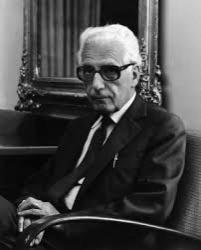
Sergiu Celibidache
 Romania
Biography of Sergiu Celibidache
Sergiu Celibidache was a Romanian conductor, composer, and educator known for his refusal to release his performances for commercial sale, believing that the listener could not experience the "transcendent experience" outside of the concert hall. His musical career spanned over five decades, earning him international recognition for his renowned interpretations of classical music. He served as the chief conductor of the Munich Philharmonic, Berlin Philharmonic, and several other European orchestras.

Sergiu Celibidache was born on June 28, 1912 (according to the Julian calendar), in a small town in northeastern Romania. His father was a government official. Celibidache began learning to play the piano during his youth. After receiving traditional training, he was sent by his father to Bucharest and then to Paris, where he studied music, philosophy, and mathematics. While his father expected him to pursue a political career in Romania, Celibidache chose to enroll at the Berlin Music School in 1936, studying composition with Heinz Thiessen and conducting with Kurt Thomas, Walter Gmeindl, and Fritz Stein. He continued his doctoral studies at the Friedrich Wilhelm University in Berlin, where he studied philosophy under Nicolai Hartmann and Eduard Spranger, and musicology under Arnold Schering and Georg Schünemann. His dissertation was dedicated to the Franco-Flemish composer Josquin des Prez and his works during the Renaissance. Celibidache obtained his doctorate in 1944.

While living in Berlin, Celibidache became acquainted with Zen Buddhism, which was practiced by his teacher Martin Steinke. Buddhist principles had a significant influence on his worldview and compositional work throughout his life. From 1945 to 1952, Celibidache served as the chief conductor of the Berlin Philharmonic. He later worked with orchestras performing on the radio in Stockholm, Stuttgart, and Paris. In the late 1940s and 1950s, he worked extensively in Britain, partly due to promotion by pianist Eileen Joyce and her partner, who was an artist agent. Joyce declared Celibidache to be the greatest conductor she had collaborated with, stating that he was able to touch her soul like no one else.

In 1970, Celibidache was awarded the international Sonning Prize for his contributions to academic music, presented in Denmark. From 1979 until his death, he served as the musical director of the Munich Philharmonic. He also taught regularly at the University of Mainz. In 1984, Celibidache lectured at the Curtis Institute in Philadelphia, Pennsylvania. Throughout his life, Celibidache dedicated himself to teaching others, often offering his courses free of charge to those interested. Some of his notable students include François Bernier, Peter Perrett, Konrad von Abel, Tom Zelle, Markand Thakar, and others.

Celibidache appeared in the film "Botschafter der Musik," conducting the Berlin Philharmonic in the performance of Ludwig van Beethoven's "Egmont" overture. While working with the Munich Philharmonic Orchestra, Celibidache became involved in a lengthy legal battle aimed at removing the principal trombonist, Abby Conant. The battle lasted twelve years, with Conant emerging victorious. Judge Angela Mack ruled that the city of Munich, through the orchestra, had violated equal treatment and equal opportunity rights for male and female employees. A detailed account of the events and Celibidache's sexist behavior is presented in an internet article published by William Osborne, Conant's husband.

In 1965, Celibidache married Ioana Procopie Dimitrescu. The couple had one son, Sergiu Ioan Celibidache, born on June 19, 1968. The composer passed away on August 14, 1996, at the age of 85, in La Neuville-sur-Essonne, Pithiviers, near Paris. Celibidache opposed the recording and subsequent sale of his concerts, considering recordings only as byproducts of his performances with orchestras. However, almost his entire concert career was recorded and released by major labels after his death. Companies such as EMI and Deutsche Grammophon obtained permission for these releases from Celibidache's relatives.

During his lifetime, Celibidache placed great emphasis on rehearsing each of his concerts, striving to create the ideal conditions for what he called a "transcendent experience." He was greatly influenced by the Buddhist concept of "ichi-go ichi-e," which emphasizes the perfect balance between preparedness and spontaneous expression. His unique concerts often stirred and moved audiences, fundamentally altering their worldview. One such notable performance was his 1984 concert at Carnegie Hall, hailed by New York critic John Rockwell as the best in Celibidache's quarter-century career. Celibidache was well-known for his high demands during rehearsals and the process of conducting itself. He often employed slower tempos compared to the norm and, at the same time, exceeded expected speeds during fast passages.