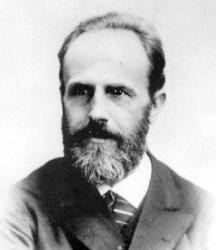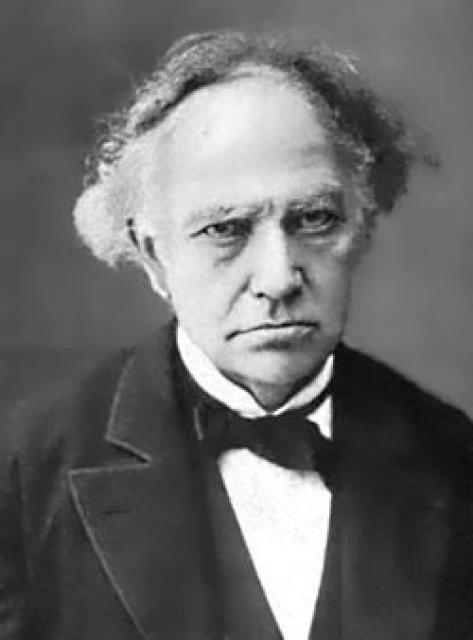
Sharl Ermiht
 France
- Charles Hermite: A French Mathematical Luminary
- Academic Career
- Contributions to Mathematics
- Recognition and Legacy
Charles Hermite: A French Mathematical Luminary
Early Life and EducationBorn on December 24, 1822, in Dieuze, France, Charles Hermite embarked on a remarkable mathematical journey. He attended Collège Henri IV before enrolling at Lycée Louis-le-Grand in 1841. Hermite subsequently joined the École Polytechnique in 1847, graduating in 1847 with distinction.
Academic Career
Hermite's passion for mathematics propelled him to lecture at the Collège de France from 1848 onwards. In 1870, he became a professor at the École Normale Supérieure and the Sorbonne. Hermite's academic credentials extended internationally, as he was elected a member of the Paris Academy of Sciences in 1856 and the Royal Society of London in 1873.
Contributions to Mathematics
Hermite's research spanned the fields of number theory, algebra, and the theory of elliptic functions. His groundbreaking work on the general algebraic equation of the fifth degree showed that it could be reduced to a form solvable in terms of elliptic modular functions.
He is renowned for his study of orthogonal polynomials, known as Hermite polynomials. Together with Arthur Cayley and James Joseph Sylvester, he developed the theory of invariants. Furthermore, Hermite's proof of the transcendence of the number e (1873) laid the foundation for Ferdinand von Lindemann's proof of the transcendence of p using a similar method.
Recognition and Legacy
Hermite's contributions to mathematics were celebrated in his lifetime and beyond. His treatise "Sur la rsolution de l`quatia du cinquime degr" (1858) became a landmark in the field of equation solving. He played a pivotal role in the study of transcendental numbers and left an enduring legacy in the annals of mathematics.
Charles Hermite died in Paris on January 14, 1901, leaving behind an illustrious legacy that continues to inspire mathematicians today.