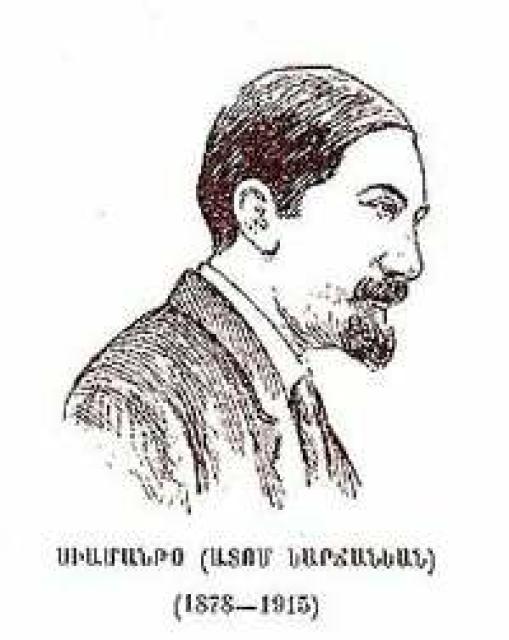
Siamanto (Atom Yardzhanyan)
 Turkey
- Biography of Siamanto (Atom Yarjanian)
- Armenian Genocide and Emigration
- Educational Journey and Literary Career
- Recognition and Poetry
- Armenian Activism and Tragic End
- The Poet's Fate
Biography of Siamanto (Atom Yarjanian)
Early Life and EducationSiamanto, born in 1878 in the town of Akn on the right bank of the Euphrates, came from a merchant family. He completed his primary education in Akn before continuing his studies in Constantinople, as advised by his family.
Armenian Genocide and Emigration
In 1894-1896, during the reign of Sultan Abdul Hamid II, the Armenian massacres took place in Constantinople and Sasun. Anticipating these events, friends of Siamanto's father advised him to take the young Atom out of the then capital of Turkey. This marked Siamanto's first experience of forced emigration. He spent almost a year in Egypt, where countless refugees sought shelter.
Educational Journey and Literary Career
Siamanto received an excellent education and studied in Geneva and Sorbonne (Paris) from 1897. He also traveled extensively in Western Europe. In 1901, his first poetry collection, "Heroic," was published in Geneva. This collection elevated the theme of the Armenian Genocide to the heights of high literature for the first time in Armenian poetry.
Recognition and Poetry
Siamanto's delicate lyricism and passionate, unique character lend his poetry a special charm. Without these qualities, his verses would be perceived as cold slogans and calls to action. It is no wonder that the literary community in Europe highly esteemed the work of the Armenian poet, even nominating him for the Nobel Prize a few months before his death. Siamanto's poems were also published in the United States, where a volume of his collected poems was released in Boston in 1910. In 1913, his epic poem "Saint Mesrop" was published separately in Tiflis.
Armenian Activism and Tragic End
Siamanto traveled extensively, advocating for the honor and dignity of his freedom-loving people. His final journey took him to Eastern Armenia in 1913-1914. He concluded his trip in Constantinople, unaware that this city would become his Golgotha. At the peak of his creative and life energies, alongside other prominent intellectuals such as Komitas, D. Varoujan, Ruben Sevak, G. Zohrab, Yeruhan, Kelekian, and many others, Siamanto was arrested and brutally murdered a few months later.
The Poet's Fate
Once, young Siamanto spoke of the poet's purpose, stating that the sole goal of an artist is to see and love beauty. However, fate destined him to become a poet of genocide, where the voices of calls and horror, despair and anxiety, are suppressed, leaving no room for even a dreamy, melancholic smile...


