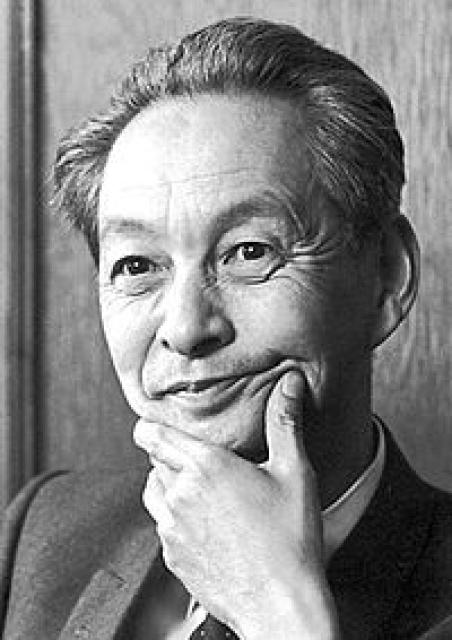
Sinitiro Tomonaga
 Japan
Japan- Shin'ichiro Tomonaga
- - Attended the prestigious 3rd High School in Kyoto.
- Research and Career:
- - Studied in Leipzig with Werner Heisenberg from 1937 to 1939.
- Conceptual Breakthrough in Quantum Electrodynamics:
- - Tomonaga and Nishina studied these processes in the early 1930s.
- Renormalization and the Success of QED:
- Nobel Prize and Legacy:
Shin'ichiro Tomonaga
Early Life and Education:- Born in Tokyo, Japan, in 1906, the eldest son of Sanjuro and Hide Tomonaga.
- Moved to Kyoto in 1913 when his father became a philosophy professor at Kyoto Imperial University.
- Attended the prestigious 3rd High School in Kyoto.
- Earned a bachelor's degree in atomic physics from Kyoto in 1929.- Continued at Kyoto as a graduate research assistant under Kajuro Tamaki.
- Collaborated with Hideki Yukawa, who later predicted the existence of the pion.
Research and Career:
- Joined the Institute of Physical and Chemical Research in Tokyo as a research assistant in 1932.
- Studied in Leipzig with Werner Heisenberg from 1937 to 1939.
- His work on the physical properties of the atomic nucleus, published while in Germany, was accepted as his doctoral dissertation at Tokyo Imperial University in 1939.
- Became a professor of physics at Tokyo University of Science and Literature (later incorporated into Tokyo University of the Arts) in 1941.
- Worked on radar during World War II, an area where Julius S. Schwinger also made contributions.
- Returned to quantum electrodynamics (QED), a field that would engage him for over 20 years.
- Made significant progress in QED in 1947, research that would earn him a Nobel Prize.
Conceptual Breakthrough in Quantum Electrodynamics:
- Aim: to reconcile quantum mechanics and special relativity.- Quantum mechanics, as formulated in the mid-1920s, successfully explained atomic structure but failed to account for the conversion of matter into energy, predicted by Einstein's special relativity.
- P.A.M. Dirac attempted to reconcile the theories by focusing on the interaction between electrons and electromagnetic radiation.
- His theory predicted that photons could materialize into electron-positron pairs and vice versa.
- Tomonaga and Nishina studied these processes in the early 1930s.
The Problem of Infinite Mass and Charge:- Dirac's theory implied that electrons should have infinite mass and electric charge.
- Tomonaga and Schwinger, working independently, addressed this issue in the 1940s.
- They showed that the electron's measured mass consists of its "bare" mass and a mass associated with a cloud of virtual photons continuously emitted and absorbed by the electron.
- Similarly, they postulated an infinite "bare" charge that attracts a cloud of virtual charged particles.
- The mathematical procedure they developed to eliminate the infinities is known as renormalization.
Renormalization and the Success of QED:
- Renormalization provided a viable framework for QED, making it the most precise physical theory.
- Electron properties can be measured to an accuracy of a few billionths, and the theory's predictions closely match experimental results.
- QED became a model for theories describing other forces in nature, and renormalization played a crucial role in their development.
Nobel Prize and Legacy:
- Tomonaga, Feynman, and Schwinger shared the 1965 Nobel Prize in Physics for their fundamental work in QED.
- Tomonaga's Nobel lecture focused on the evolution of the ideas that led him to pursue this research.
- His work, initially overshadowed by the war, gained international recognition through the efforts of Hideki Yukawa.
- After the war, Tomonaga returned to Japan and held various leadership positions in research institutions and scientific organizations.
- He received numerous awards, including the Order of Culture from the Japanese government and the Lomonosov Gold Medal from the USSR Academy of Sciences.