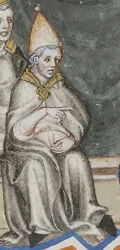
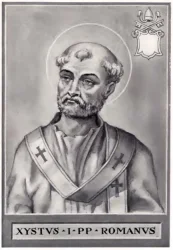
Sixtus I
Sixtus I led the Christian community at Rome during the early second century, a period when the church’s leadership and institutions were still taking shape. Later Catholic tradition counts him as the seventh pope, but the surviving evidence about his life is sparse. The dates of his episcopate vary among ancient sources, and many stories attached to him emerged centuries after his death.
A bishop in early Rome
Sixtus is also known by the Greek form Xystus. He is generally placed in office around 115 or 119 CE and said to have served for roughly a decade, perhaps until 125 or 128. The historian Eusebius of Caesarea preserved differing chronologies in his Chronicle and Church History, so the exact dates remain uncertain.
Very little is known about Sixtus’s origins or personal life. Some later accounts identify him as a Roman of Greek ancestry, but this claim is not firmly established by contemporary evidence. In his era, the bishop of Rome led a community that was growing in size and influence, although the centralized papal office familiar from later centuries had not yet developed in its mature form.
Tradition and historical uncertainty
Later church histories credit Sixtus with rules about who could handle sacred vessels and how clergy should communicate with Rome. Other traditions associate him with the use of the Sanctus in the Mass. Modern historians treat these regulations cautiously, since the texts attributed to him appear to reflect later church practices rather than the second century.
Sixtus is venerated as a saint in the Catholic Church, and some later sources call him a martyr. The earliest accounts do not clearly establish that he was killed for his faith, however. His burial was traditionally associated with the Vatican necropolis, but the details of his resting place are also uncertain.
The historical record leaves Sixtus less a vivid biography than a place in the succession of Rome’s early bishops. His name survives through lists, church calendars, and later accounts that sought to trace continuity back to the first Christian generations. The uncertainty around his dates and attributed reforms is itself a reminder that the earliest history of the papacy must often be reconstructed from fragmentary and much later evidence.