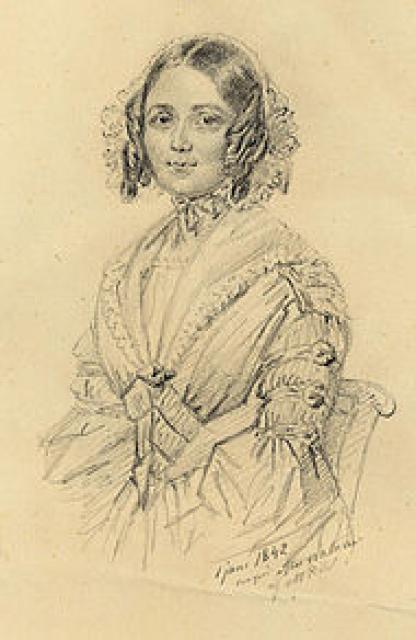
Sophie Knorring
 Sweden
Sophie von Knorring brought the pressures of love, marriage, and social rank into the center of the Swedish novel. Writing from an aristocratic woman’s point of view, she moved between drawing rooms and country estates, combining vivid conversation with psychological observation and an often sharp eye for hypocrisy. Her fiction helped shape the emergence of realism in Sweden during the 1830s and 1840s.
An Aristocratic Upbringing
Born Sophia Margareta Zelow on September 28, 1797, she grew up at Gräfsnäs in Västergötland. Her father, Christer Göran Zelow, was a military officer and court official who managed the family’s estate. When Sophie was a girl, the family moved to Högärdet near Vänersborg. Financial difficulties later narrowed the family’s prospects, even as her education prepared her and her sisters for life in society.
From 1810 to 1813, Sophie and her younger sisters lived in Stockholm for their education. They studied languages, music, singing, painting, dance, religion, history, and literature. The city’s theaters left a strong impression on her, as did the visit of the French writer Madame de Staël, whom Sophie met in 1812. Years later, she drew on that memory in her novel Illusionerna.
In 1820, she married Baron and Colonel Sebastian Carl von Knorring. The couple moved to his military residence near Tidan, and their daughter Ebba was born the following year. Estate life brought hard practical work and periods of financial strain, experiences that would later inform Sophie’s close attention to household routines and the lives of people living beyond the capital.
A New Kind of Swedish Novel
Her literary career began in 1834 with Cousinerna, published through a Stockholm press after another publisher had declined it. She initially kept her identity at a distance, and her novels were associated with the phrase “the author of Cousinerna.” That anonymity offered a measure of protection in a literary world where women writers were routinely judged not only for their books but for their respectability.
Cousinerna received mixed reviews, but it established her voice: emotionally direct, witty, and attentive to the social codes shaping women’s choices. She followed it with Vännerna in 1835, then Qvinnorna, Axel, and Illusionerna in 1836. Many of these novels unfold in Stockholm salons and country houses, where characters weigh desire against duty. Love is often intense, but marriage and social convention remain powerful forces.
Her books differed from the domestic family novels associated with Fredrika Bremer. Von Knorring’s prose drew on continental social fiction and favored spirited dialogue, irony, and close observation of status. Critics sometimes considered her approach unconventional, yet her stories made women’s emotional lives and constrained choices central to the narrative.
Class, Country Life, and Lasting Work
From the late 1830s, her focus widened to the relationships between social classes. Stånds-paralleler (1838) examined different layers of rural society, while shorter stories appeared in the collections Skizzer in 1841 and 1845. In Torparen och hans omgifning (1843), she attempted a detailed portrayal of agricultural laborers and criticized the arrogance of landowners. The work is regarded as an early Swedish novel centered on rural working life.
Her fiction could be socially observant while remaining rooted in aristocratic values. She defended the permanence of marriage, even as her plots explored forbidden attraction and emotional conflict. This stance brought her into debate with the more liberal writer Carl Jonas Love Almqvist. Her novel Förhoppningar (1843), about a widow’s forbidden love for her stepson, is among her most psychologically probing works.
Von Knorring moved in a broad literary circle and knew Fredrika Bremer and Malla Silfverstolpe, despite differences in their views on women’s emancipation. Her work was translated into German, English, and French, giving her readers beyond Sweden. She suffered from tuberculosis for years and died at Skålltorp near Skara on February 13, 1848, aged 50.
Her novels remain notable for their combination of feeling and social critique. By portraying the rules of aristocratic life from the perspective of women who had to live within them, she helped Swedish fiction turn toward sharper psychological realism and more complex pictures of everyday society.