Srinivasa Ramanujan
 India
India- Srinivasa Ramanujan: A Mathematical Prodigy
- Mathematical Influences
- Collaboration with G.H. Hardy
- Mathematical Achievements
- Mathematical Genius
- Personal Life and Death
Srinivasa Ramanujan: A Mathematical Prodigy
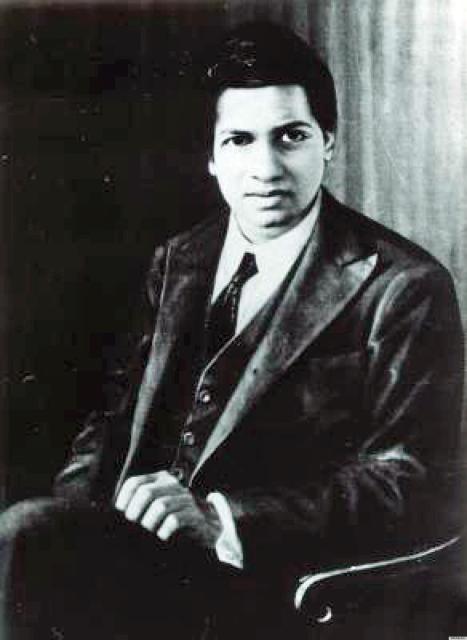
Early Life and EducationSrinivasa Ramanujan, an Indian mathematician and Fellow of the Royal Society, was born on December 22, 1887, in Chennai, India. Despite lacking formal mathematical training, he made remarkable contributions to number theory. As a young boy, he exhibited extraordinary mathematical abilities, studying trigonometry from a friend's books and discovering Euler's formula on sine and cosine at the age of 14.
Mathematical Influences
At the age of 16, Ramanujan encountered George Shoobridge Carr's "Synopsis of Pure and Applied Mathematics." This comprehensive work, containing 6,165 theorems and formulas, served as a significant influence on his mathematical development. Its lack of proofs and explanations fostered Ramanujan's unique approach to problem-solving and profound understanding of mathematical patterns.
Collaboration with G.H. Hardy
In 1913, Ramanujan wrote a letter to renowned Cambridge University professor Godfrey Harold Hardy, sharing his unconventional mathematical discoveries. Hardy was intrigued by Ramanujan's remarkable formulas and invited him to come to Cambridge. Ramanujan arrived in 1914 and became a professor at the university, while also being elected as a Fellow of the Royal Society.
Mathematical Achievements
Ramanujan's mathematical interests encompassed a wide range of topics, including magic squares, circle quadrature, infinite series, smooth numbers, partitions of numbers, hypergeometric functions, and special sums and functions that now bear his name. His work with Hardy on the asymptotic behavior of the partition function p(n) is particularly significant.
Mathematical Genius
Ramanujan possessed an exceptional ability to observe and analyze numbers, referring to each natural number as a "personal friend." His intuitive understanding and novel approaches to problem-solving have left a lasting legacy in mathematics. Many mathematicians of his time considered him an exotic phenomenon, believing that his brilliance was anachronistic.
Personal Life and Death
Ramanujan returned to India in 1919 but passed away shortly after due to complications from tuberculosis, malnutrition, and stress. He died at the young age of 32, leaving behind a remarkable body of work that continues to inspire and challenge mathematicians even today.