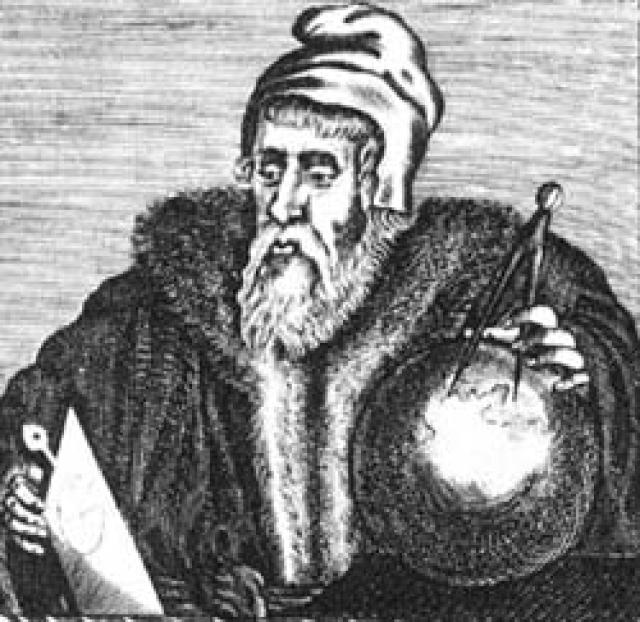
John Dee
 Great Britain
The Mysterious Life of John Dee
Who was this legendary figure, Dr. Dee, whose magical legacy still captivates the imagination? He was a remarkable individual who was highly esteemed by knowledgeable people even to this day. In the late 16th and early 17th centuries, the fame of this English scholar, who signed his name as "Voo," spread throughout Europe. There are records of a black crystal, once owned by the legendary John Dee, from the late 16th century. Manuscripts, once stored in the Cotton Library, detailed this magical mirror. The mirror was part of a collection of curiosities belonging to Horace Walpole of Strawberry Hill. It resembled a perfectly polished black coal, cut in an oval shape with a handle made of dark ivory. Although many said it was coal, there was no certainty. Perhaps it was another mineral. Regardless, the mirror was kept in the Peterborough collection with a cautious inscription: "Black stone through which Dr. Dee summoned spirits." Elias Ashmole, author of the curious and eerie book "Chemical Theater," described this black mirror with great enthusiasm: "With the help of this magical stone, one can see any face, no matter where it is in the world, even if it is hidden in the most remote corners or caves within the earth." The Peterborough and Walpole families, fearing its power, never attempted to use the magical mirror themselves and kept it away from prying eyes. They were afraid of the potential dangers that someone's curiousity could bring. But in 1842, the Walpole collection was put up for sale. The magical crystal was sold for twelve pounds (according to French sources, for 336 francs) to an anonymous buyer. Despite extensive searches, neither the mysterious buyer nor John Dee's black mirror could be found.
Biography of John Dee
John Dee was an astronomer, mathematician, philosopher, cartographer, optician, and alchemist. He was born in Wales, the son of a court officer of King Henry VIII. At the age of fifteen, he entered St. John's College, Cambridge. He continued his education in the Netherlands and Belgium. Even as a young man, he taught geometry to Emperor Charles V of the Holy Roman Empire. By the age of 23, he was giving his famous lectures on mathematics in Paris.
Dee was a brilliant mathematician and astronomer, a renowned scientist, a connoisseur of classical philology and languages, a passionate collector and savior of ancient manuscripts, owner of one of the largest personal libraries in Europe, an outstanding philosopher, the "spiritual father of Rosicrucianism," a visionary, and a person who could sleep only two hours a day. He is also considered the prototype of Shakespeare's Prospero. When Dee returned to England, he was not yet 30 years old. However, he was already a respected scholar, and Queen Mary I appointed him as her royal astrologer. Shortly after her coronation, Dee predicted that Mary's reign would be short-lived, as she would soon die without leaving an heir. The spies immediately informed Mary about these treasonous predictions, and Dee was thrown into prison for "attempting to influence the life of the monarch with magic."
Dee spent two years in imprisonment. Nevertheless, his prediction came true, and Elizabeth I ascended to the throne. She trusted the young scholar implicitly and appointed him as her royal astrologer. She even chose the date and time of her coronation, January 14, 1559, based on Dee's calculations. Elizabeth's reign, known as the Elizabethan Renaissance, was highly successful. It was a time of cultural and scientific flourishing, expanding trade, and geographical discoveries. Historians believe that John Dee played a significant role in this golden age.
Elizabeth also provided Dee with ample opportunities for scientific activities. With her patronage, Dee made significant contributions to his country. He invented mechanical robots and telescopes and played a crucial role in the development of maritime navigation and the use of binoculars and telescopes in the English army. He was one of the first to propose the use of solar energy focused through a giant mirror.
Dee was involved in the reform of the Gregorian calendar, wrote a geography textbook, proposed the idea of a prime meridian (now known as the Greenwich Meridian)... The scope of his achievements was extraordinary. However, amidst his active pursuits, John Dee lived a secret life, the nature of which we can only partially guess from his personal and "spiritual" diaries and autobiographical treatises. Reading between the lines, we can confidently say that this unique individual had a peculiar blend of mysticism and advanced science. He took occult philosophy and magic seriously as a worldview that could help penetrate the mysteries of existence. His fundamental philosophical work, "Monas Hieroglyphica" (Antwerp, 1564), is considered the ideological foundation of future Rosicrucianism by researchers of secret societies and hermetic teachings.
It is safe to say that Dee devoted much of his time to esoteric sciences such as Kabbalah, numerology, alchemy, astrology, and divination. He also studied the properties of mirrors. However, very little is known about this area of his research, and we can only rely on his sparse notes. For example, he wrote, "It is easy to create a mirror that turns all kinds of stones and metals into ashes using the power of the sun, even when it is hidden by clouds." Contemporary witnesses also claimed that Dee had a chamber for "mirror visions" in his home.
Despite the losses and persecution he endured, John Dee never lost interest in his research and continued to experiment with magical crystals and mirrors throughout his life. He would often gaze into their mysterious depths and sometimes see things that we can only speculate about. For example, one such day that stood out was May 25, 1581. Dee made a short diary entry about it: "I gazed into the crystal for a long time - and finally saw." What exactly shocked John Dee remains unknown. However, he may have been referring to it in another passage: "This is what I have been searching for many years, in different lands, far and near; I have read countless books and learned many languages, I have interacted with various people, and I have worked hard to catch a glimpse of true knowledge... Seeing this, I realized that wisdom cannot be attained through human effort, but only by Your will (O Lord)." A year and a half later, an extraordinary event occurred in Dee's life that had far-reaching consequences. In November 1582, during his evening prayer, a supernaturally radiant being - a child, whom Dee later called the angel Uriel, the "spirit of light" - appeared to him in all its glory. The content of their conversation remained a secret, but it is known that the "angel" gave Dee a magical crystal "the size of an egg, transparent and shimmering with all the colors of the rainbow." According to Dee, the archangel Michael immediately appeared before him with a flaming sword and commanded, "Go and take it, but let no living soul touch it." And so Dee did.
Unfortunately, Dee himself did not always succeed in obtaining visions through the "angel's stone." Therefore, he began to rely on assistants who were more clairvoyant. These assistants would gaze into the crystal and report everything they saw to Dee. He diligently recorded their observations. One of these assistants, Edward Kelley, described the process: "In the middle of the stone, there is a small, round flash of light that appears like a sphere with a diameter of thirty inches [76 cm] or so." Kelley claimed that in the shining sphere, they could see "spiritual beings" who provided Dee with a variety of information.
Dee cherished this gift throughout the remaining quarter-century of his life. And there were good reasons for that. According to the available records, this magical crystal allowed him not only to access other worlds but also to catch glimpses of the future. According to John Dee himself, he taught non-human intelligent beings, such as the elf girl named Madina and the "angels" named Ave and Raphael, the mysterious language. This happened after the "angels" showed him a table with letters, numbers, and symbols in the crystal. It was a very strange alphabet, whose writings still arouse the keen interest of researchers. After all, this invention by John Dee was essentially the first known artificial language in history (and perhaps the first known language of extraterrestrial civilizations?). Dee called it Enochian - the language of Enoch, spoken by "angels and inhabitants of the Garden of Eden." Today's scientists consider it a complete language system with its own alphabet and grammar, completely different from any human language.
Fragments of Dee's writings in this mysterious language have survived. Researchers are amazed to find that they contain mathematical knowledge far beyond the level of that time. His contacts with the "angels" continued for several years, and during this time, Dee received extraordinary knowledge for that time from them.
The most astonishing thing is that this enchanted stone did not disappear, as often happens with legendary relics. Over the course of four centuries, it passed through the hands of different people and is now kept in the British Museum. The administration does not allow outsiders to use or study it...