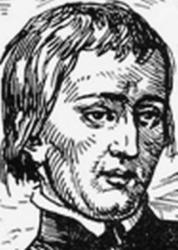
Stefan IAvorskij
 Poland
Biography of Stefan Yavorsky
Famous hierarch Stefan Yavorsky (born Simeon) was a renowned religious leader. He was born in 1658 in the Polish town of Yakore, in an Orthodox family. After the Treaty of Andrusovo, which gave the right-bank Ukraine to Poland, the Yavorsky family, wanting to remain faithful to Orthodoxy, moved to the village of Krasilovka near Nezhin. Stefan learned to read and write in his hometown and furthered his education at the Kiev-Mohyla Academy. The teaching at the academy was conducted in Latin, in a strict scholastic style. In the final years of his time at the academy, Yavorsky had the opportunity to attend lectures on theology and philosophy by the renowned scholastic Joasaph Krokovsky and gained the patronage of Varlaam Yasinsky, later the Metropolitan of Kiev. In 1684, he wrote a panegyric in his honor titled "Hercukes post Atkantem, infracto virtutum robore honorarium pondus sustinens", where Hercules represents Yasinsky and Atlas represents his predecessor Hizel. The panegyric was written in Latin, alternating between verse and prose, and interspersed with Polish verses. In 1684, Stefan left Kiev and, in order to gain access to Catholic schools, he had to publicly convert to Catholicism under the name Stanislaw Simon (this was not uncommon at that time). Stefan attended Catholic schools in Lviv and Lublin, where he studied philosophy, and in Poznan and Vilnius, where he studied theology. He became well-versed in scholastic knowledge, composed poetry in Latin, Polish, and Russian, and wrote magnificent panegyrics (in honor of Mazepa, and later, Peter the Great). He also gained a thorough understanding of Catholic theology and developed a hostile attitude towards Protestantism during his time in Polish schools. Stefan returned to Kiev in 1687, repented for his conversion from Orthodoxy, and was readmitted to the Orthodox Church. At the advice of Varlaam Yasinsky, he became a monk in 1689. For several years, he taught at the Kiev-Mohyla Academy and served as its prefect, lecturing on rhetoric, poetry, philosophy, and theology. There are reports that Stefan "firmly established papal teachings in the Kiev schools" in the pamphlet "Hammer on the Stone of Faith" and in letters from Jerusalem Patriarch Dosifei. In the dispute over the time of consecration of the holy gifts, Stefan did not side with either the Great Russians or the Little Russians, but held a middle position. In 1697, he was appointed the abbot of the Holy Nicholas Desert Monastery. He became a close aide to the Metropolitan of Kiev in his dealings with the Moscow government, frequently carrying out various church-administrative tasks and traveling to Moscow. In January 1700, when the Metropolitan sent Stefan and another abbot to Moscow, he also sent a letter to the Patriarch requesting the establishment of the Pereyaslavl Diocese and the appointment of one of the two abbots as bishop. In Moscow, a chance event propelled Stefan forward: Voivode Shein died, and Stefan was entrusted with delivering the sermon at his funeral in the presence of the Tsar. Peter was impressed by both the sermon and the preacher and directed Patriarch Adrian to ordain Stefan as a bishop for one of the Great Russian dioceses "where it is appropriate, not far from Moscow". Stefan, who was inclined towards Kiev, tried to decline this honor, but in April 1700, he was consecrated as the Metropolitan of Ryazan and Murom. In the same year, after Adrian's death, the Tsar appointed Stefan as the locum tenens of the Patriarchal See. By choosing Stefan, the Tsar primarily saw him as a person with Western education, which was lacking in the Moscow clergy. Additionally, in the eyes of Peter, Stefan was a new person, free from the traditions of the old Moscow party. Supporters of tradition were not pleased with his appointment. He was seen as a foreigner and someone who brought Latin heresies from Polish schools. Initially, Stefan supported Peter's policies and military campaigns in his sermons, often delivering brilliant panegyrics (from a scholastic perspective) on military matters. To appease the Tsar, Stefan appointed foreigners, educated individuals, to the bishopric positions. He reformed the Moscow Academy, replacing Greek teachings with Latin scholasticism in both methods and content. Stefan's church-administrative activities were not extensive; his authority as the locum tenens was limited by Peter, and in exchange, the Monastic Department was established under secular administration. In matters of Church affairs, Stefan often had to consult with the Council of Bishops. Over time, Peter's tendencies towards limiting the power of the Church became evident. It became clear that Peter had no intention of appointing a patriarch and, on the contrary, planned to abolish the patriarchate itself. In 1711, fiscal officials from the civil administration were introduced into church courts. In 1715, Peter openly expressed his attitude towards the patriarchate and the hierarchy in his humorous parodies of church ceremonies. At the same time, he developed friendly relations with Protestants and Protestantism. Stefan found himself among the supporters of tradition, becoming an obstacle (though not an active one) to Peter's reforms, and gradually losing his significance. Stefan, despite his life experiences and education, was not a supporter of tradition. However, the Catholic principles he acquired hindered his support for the reformer. Sometimes, the content of protest inspired by Catholicism coincided with the content of protest from the traditionalist party. Like the latter, Stefan opposed the extent of ecclesiastical power, as he adopted the Catholic principle of the church's supremacy. This led to difficulties for Stefan. Using the convoluted form of scholastic preaching, Stefan often made unfriendly allusions to the actions of the Tsar. Aware of his inability to openly confront the Tsar, he repeatedly requested retirement, but to no avail. Peter kept him close until his death, implementing various reforms under his sometimes reluctant blessing. Stefan lacked the strength to openly break with the Tsar, but at the same time, he could not reconcile himself with what was happening. In 1712, Stefan sharply criticized the institution of fiscals and the current state of Russia, calling Tsarevich Alexei the "sole hope" of the country. Senators who heard the sermon immediately passed its contents to the Tsar. Peter did not confront Stefan directly but maintained the senatorial ban on his preaching. During the trial of Alexei in 1718, the Tsar ordered Stefan to come to St. Petersburg and kept him there until his death, depriving him of even the minimal authority he previously held. Around the same time, an incident occurred with Feofan Prokopovich. Stefan did not want Feofan to be appointed as a bishop, as he believed that his teachings and lectures showed strong traces of Protestant influence. The Tsar listened to Feofan's justifications and appointed him as a bishop, and Stefan was required to apologize to Feofan. Stefan did so, feeling that he was in the right. Stefan's church-administrative activities came to a complete halt; he did not participate in the preparations for church reform, and the Spiritual Regulation and church administration proceeded without his involvement. Stefan attempted to clarify his position in 1718 by asking the Tsar: 1) whether he should return to Moscow or live in St. Petersburg, 2) where he should live in St. Petersburg, 3) how he should manage his diocese remotely, 4) whether to summon bishops to St. Petersburg, and 5) how to fill vacant bishopric positions. The Tsar instructed him to live in St. Petersburg, build a residence at his own expense, and manage the Ryazan diocese through the Archbishop of Krutitsy, among other instructions. Finally, the Tsar wrote: "for better future administration, it seems necessary to have a collegium in order to more conveniently manage such a great affair in the future." In February 1720, the regulations for the Holy Synod were approved, and a year later, the Synod was established. Stefan was appointed as its president, despite having less sympathy for this institution than the others. Stefan had no influence on Synodal affairs; the Tsar, apparently, kept him only to use his name as a sanction for the new institution. During his time in the Synod, Stefan was constantly under investigation for political matters. He was often interrogated based on accusations by individuals like Lubimov, who claimed that Stefan sympathetically supported Lubimov's writings (1721), and monk Levin, who alleged that Stefan had said to him: "The Tsar appointed me to the Synod, but I did not want to, and for that, I stood before him on my knees under a sword," and "I myself wish to leave for Poland" (1722). Upon closer examination, these accusations were found to be baseless, but Stefan was continually interrogated. He also found no solace in his attachment to the monastery he established in Nezhin, as he discovered significant embezzlement of funds sent to him for the monastery's construction. All of these troubles shortened Stefan's life. He donated his library to the Nezhin Monastery, including a touching elegy in Latin. Stefan died in Moscow on November 24, 1722. Stefan was admired by his contemporaries for his preaching skills. Even his enemies spoke highly of his sermons, saying, "it is true that Stefan Yavorsky had an extraordinary gift of eloquence, and few Russian teachers could match him. I have had the opportunity to see that his teachings could elicit laughter or tears from his listeners, greatly aided by his body movements, gestures, and facial expressions, which nature bestowed upon him." Perhaps Stefan's unique style of preaching ensured his success, although it is not easily understood by present-day audiences. Despite his eloquence, Stefan remained loyal to Catholic tendencies in his speeches. His sermons are characterized by abstraction and detachment from life, with highly refined construction ("people are like fish. Fish are born in water, people are born in the waters of baptism; fish are tossed by waves, people too" and so on). Formal aspects of Stefan's sermons are rich in elaborate symbols, allegories, and wordplay. Overall, his sermons embody all the characteristics of Catholic preaching in the 16th and 17th centuries. He also wrote a treatise titled "Signs of the Coming of the Antichrist and the End of the World," which was referenced as evidence that Peter was the Antichrist. After Stefan's death, he continued to be the subject of controversy, with some polemicists even suggesting that he was a secret Jesuit. Stefan's sermons were published in Moscow in 1804-1805. Other works by Stefan include "The Rhetorical Hand," translated from Latin by Fedor Polikarpov, published by the Society of Lovers of Ancient Writing; unpublished sermons of Stefan Yavorsky with an article by I.A. Chistovich, published in St. Petersburg in 1867; "Feofan Prokopovich and His Time" by Chistovich (St. Petersburg, 1868); "Feofan Prokopovich as a Writer" by P.O. Morozov (St. Petersburg, 1880); "Moscow Freethinkers at the Beginning of the 18th Century and Stefan Yavorsky" by N.S. Tikhonravov; "From the History of the Slavic-Greek-Latin Academy" by Smirnova and "Science and Literature under Peter the Great" by Pekarsky. The analysis of Stefan's reality as a theologian, church official, and preacher is provided in the work "Stefan Yavorsky and Feofan Prokopovich" by Y.F. Samarin (Moscow, 1880). Also, see Smirnova's "History of the Slavic-Greek-Latin Academy" and Pekarsky's "Science and Literature under Peter the Great".