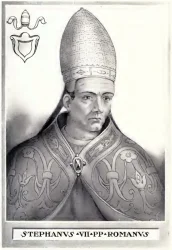
Stephen III
Stephen III, also numbered Stephen IV in some older lists, became pope in 768 after a violent struggle over control of the papal office. A Sicilian cleric who had spent much of his career in Rome, he inherited a church unsettled by rival claimants and political interference. His response included a major council that attempted to change the rules of papal elections and reinforce the authority of the clergy.
From Sicily to the Lateran
Stephen was born in Sicily, the son of a man named Olivus, and came to Rome at a young age. He served in the papal administration under Pope Stephen II and Pope Paul I, eventually becoming a priest at the church of Santa Cecilia. His long experience in the Lateran offices gave him a close view of the political rivalries surrounding the papacy.
After Paul I’s death in 767, factions in Rome fought for control of the succession. Members of the military aristocracy elevated Constantine, a layman, as pope; after his removal, another faction briefly installed a rival, Philip. Stephen was elected on August 1, 768, and consecrated a few days later, with the backing of the clerical party led by the official Christophorus.
Rewriting the rules
To address the crisis, Stephen convened a council at the Lateran in April 769, attended by bishops from across Italy and representatives of the Frankish kingdom. The council condemned Constantine’s elevation, declared his acts invalid, and established rules intended to prevent a repeat of the episode. It limited eligibility for the papacy to members of the clergy and restricted the decisive role in elections to clerics, while leaving the laity a formal part of the process.
The council also rejected the iconoclast decrees of the Byzantine Council of Hieria in 754, which had opposed the veneration of religious images. Its decisions reflected both the theological divisions between Rome and Constantinople and Rome’s desire to assert greater independence from imperial authority.
A difficult political landscape
Stephen’s papacy unfolded in a complex balance of local and international power. The Lombards remained a threat to the Papal States, while the Franks, under Pepin the Short and his sons, were becoming the papacy’s most important allies. Stephen maintained these ties, but he also faced conflict within Rome. Christophorus, who had helped secure his election, was later forced from the city amid factional maneuvering, demonstrating how fragile papal authority remained.
Stephen died on January 24, 772, after a pontificate of a little more than three years. He was followed by Adrian I, whose much longer reign would strengthen relations with Charlemagne. Stephen is remembered chiefly for the 769 Lateran council and its attempt to put papal elections on a more regular clerical footing. The rules did not end political interference, but they marked an important stage in Rome’s ongoing effort to define who could choose its bishop and under what authority.