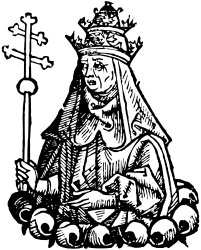
Benedict IV
Benedict IV led the Roman church during a turbulent stretch of the early tenth century, when rival claimants competed for power in Italy and the papacy was recovering from a bitter internal schism. His pontificate is sparsely documented, but two actions stand out: he defended the legacy of Pope Formosus and crowned Louis the Blind as emperor in 901. Both decisions placed the pope at the center of the political struggles of his age.
A Roman priest becomes pope
Benedict was a Roman and the son of a man named Mammalus. The exact date of his election is uncertain, but he became pope in 900, succeeding John IX. Before his election, he had been ordained a priest by Formosus, whose disputed papacy had become a flashpoint in Roman politics.
After Formosus’s death, Pope Stephen VI had subjected his corpse to a notorious posthumous trial, annulled his acts, and punished his supporters. Pope John IX later reversed that condemnation. Benedict continued to uphold Formosus’s status, and a Lateran synod under his leadership in 900 affirmed the legitimacy of Formosus’s ordinations and consecrations. The decision helped settle a church dispute that had been entangled with rival political factions in Rome.
An imperial coronation
Benedict’s best-known political act came in February 901, when he crowned Louis III, known as Louis the Blind, emperor in Rome. Louis, king of Provence, had been invited into Italy by nobles opposed to Berengar I, who was then consolidating his own claim to power. The coronation was an attempt to shape the balance of authority in Italy and to preserve a strong imperial protector for Rome.
The arrangement did not last. Berengar defeated Louis’s forces in 902 and compelled him to leave Italy. The episode illustrates the limited reach of papal diplomacy in a period when rulers depended on alliances and military strength as much as on ceremonial legitimacy.
A short and shadowed pontificate
Benedict also addressed disputes over church offices in France and southern Italy, supporting local bishops whose positions had been contested. These interventions show that even under difficult political conditions, Rome remained an important center of appeal for church communities beyond the city.
Benedict died in the summer of 903. The sources offer little about his personality or private life, but they preserve the image of a pope who tried to repair divisions within the church and use the authority of the papacy to influence Italian politics. His reign came during one of the most unstable periods in medieval Rome, and his careful support for Formosus’s legacy and his coronation of Louis marked a brief effort to restore order.