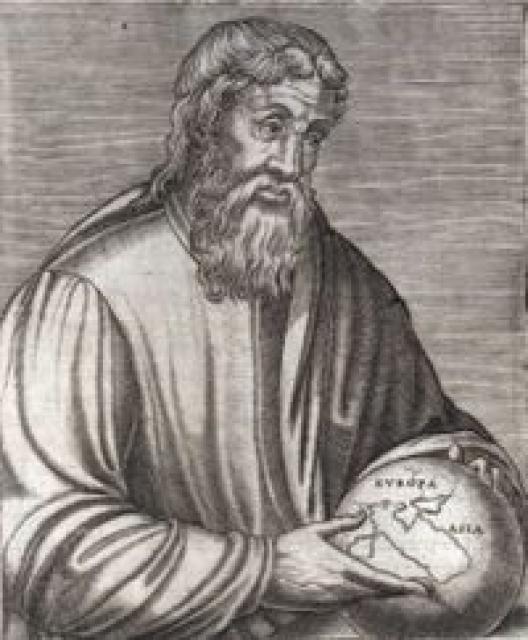
Strabon
 Greece
Biography of Strabo
Strabo was an ancient Greek geographer and historian who lived during the first century BC. He was born in 63 BC in Amaseia, a city located about one hundred kilometers from the southern coast of the Black Sea, on the road leading to the Mediterranean. It was in Amaseia that Strabo's parents settled after moving from the island of Crete. Unfortunately, not much is known about his father. In his writings, Strabo provides detailed information about his maternal relatives, emphasizing the nobility of his lineage.
The founder of the Stoic school of philosophy, Zeno, who lived two centuries before Strabo, had a strong influence on shaping the future geographer. Strabo was not gifted with a talent for writing or original thinking. However, his strength lay in his meticulousness, his ability to collect and synthesize facts, and his comprehensive knowledge, which is often referred to as encyclopedic.
Travels and Works
Strabo extensively traveled throughout his life, relying on his own observations whenever possible. During Strabo's time, the Romans constructed magnificent roads. These roads were meticulously planned, covered with gravel or paved with bridges and equipped with drainage ditches. The main highway led from Britain, through Europe, to Illyria (in the Balkans), then into Asia Minor and Syria, finally reaching the Indian Ocean. Another route ran from Cadiz, through the Pyrenees, Gaul, and the Jura Mountains, to Vindobona (Vienna). The Romans left a legacy of 90,000 kilometers of main roads and 150,000 to 200,000 kilometers of secondary roads in medieval Europe and Byzantium.
Tourism became a common and fashionable activity during this time. Special bureaus provided travelers with guides, directories, and travel books. Geographic maps were displayed on walls, and one such map adorned the wall of a Roman palace. Travel handbooks sometimes took unexpected forms, such as a silver vessel adorned with a route from Gades (Cadiz) to Rome, including all intermediate stations and distances between them. There is no information indicating that the "Seven Wonders of the World" were destinations for travel or part of a specific itinerary, but many individuals sought to see each wonder individually, and Strabo was no exception.
It is presumed that during his time, people firmly believed that there were indeed seven wonders. They were named as such as early as the 3rd century BC. Strabo described five of these wonders. At that time, the Hanging Gardens of Babylon no longer existed. Although he praised the statue of Zeus at Olympia, created by Phidias in the 5th century BC, he did not include it as one of the wonders, nor did he mention the Temple of Artemis at Ephesus or the Pharos Lighthouse, both of which he had seen firsthand.
Strabo provides a brief description of the Pharos Lighthouse, stating that it is a rock washed by the sea, with an astonishing multi-story tower made of white marble. According to the inscription, the tower was a gift from Sostratus of Cnidus, a friend of kings, to ensure the safety of sailors. Strabo provides slightly more detail about the Temple of Artemis at Ephesus, listing the builders and benefactors of the sanctuary and briefly mentioning the architects and the infamous Herostratus. It is believed that Strabo did not want to write about well-known wonders, especially if they were not directly related to his geographical tasks.
Strabo visited Egypt multiple times. Based on his descriptions, it is still possible to easily create a city plan of Alexandria. He also mentions that during the prefecture of Aelius Gallus, he traveled along the Nile and accompanied him until Syene and the borders of Ethiopia. The route was not new, as thousands of travelers seeking to explore the land of the pharaohs had previously traversed the narrow Nile valley.
From Alexandria, the road led to Canopus, connected by a twenty-kilometer canal. In Canopus, Strabo was intrigued by the Serapeum, a temple where the sick were put to sleep to receive instructions for their healing in their dreams from an oracle.
Some tourists continued their journey southward to Heliopolis. There, the delta ended and the true Nile began. Strabo visited Memphis, the oldest capital of Egypt, and briefly mentions the pyramids, the only surviving witnesses of its history. He then turns his attention to the sacred bull Apis, considered the embodiment of the god Ptah in Egyptian beliefs.
Near Memphis, by Lake Moeris, there was an astonishing structure built by Pharaoh Amenemhat III in the 19th century BC. Among all the researchers who wrote about the labyrinth, Strabo is the only one who reveals the political significance of this enigmatic palace. The enormous labyrinth symbolized all of Egypt, united under the rule of the pharaoh, connecting the people and the state into a single entity.
Strabo also traveled through Cappadocia and Phrygia in Asia Minor, explored the Taurus Mountains and the foothills of the Caucasus, visited the shores of Ionia (Ephesus), the Cycladic islands, and Corinth. The seventeenth book of "Geography" reads more like a travel diary than a scientific work. It contains details that are not found in any other ancient author.
The most interesting and reliable parts of Strabo's work are those written from his own personal observations.


