Tadeush Makovskiy
 Poland
- Tadeusz Makowski: A Polish Master
- Parisian Influence
- Return to Realism and Emergence of the Child Motif
- Grotesque Transformations
- Legacy and Preservation
Tadeusz Makowski: A Polish Master
Early Life and EducationTadeusz Makowski (1882-1932) was born into a humble family of government officials. His family moved to Krakow for his secondary education. Initially, Makowski's father desired him to pursue mathematics. However, the young man harbored a strong affinity for the humanities and art, which his mother supported. In 1902, Makowski enrolled at the University of Krakow, studying philosophy and philology. Concurrently, he began attending the Krakow Academy of Fine Arts in 1903.
After three years, Makowski decided to dedicate himself fully to the visual arts, leaving the university. His teachers at the academy included acclaimed Polish painters Julian Mehoffer and Jan Stanisławski. Makowski graduated with a silver medal and set his sights on the "capital of artists," Paris, for further training.
Parisian Influence
In 1908, after a brief stint in Munich, Makowski settled in Paris. Initially, he intended to stay for a year, but he ultimately remained in France until his death. Despite his Parisian residence, Makowski remained a devoted Polish artist, as both his roots and the distinct national character of his art attested.
Influenced by the monumental decorative panels of Pierre Puvis de Chavannes, Makowski initiated a "fresco" period in his work. His paintings during this time adhered to the principles of fresco painting, emphasizing flatness, harmonious colors, and decorative compositions.
However, the vibrant Parisian art scene soon prompted Makowski to reevaluate his style. Puvis de Chavannes' work began to appear archaic. Makowski sought guidance from Armand Le Fauconnier, a prominent figure in French modern art. The doctrines of Cubism, which gained considerable traction during this period, also influenced Makowski.
Return to Realism and Emergence of the Child Motif
Over time, Makowski grew disillusioned with the limitations of Cubism. In his lifelong diary, he wrote in December 1913: "I prefer to paint realistically. The material substantiality of the image in painting is its richness. I want to create life with colors."
Makowski's return to realistic art was fueled by his study of the works of Pieter Bruegel the Elder, Rembrandt, and the Dutch masters. He also engaged with nature firsthand, spending summers in Brittany and Auvergne, where he painted landscapes and portraits.
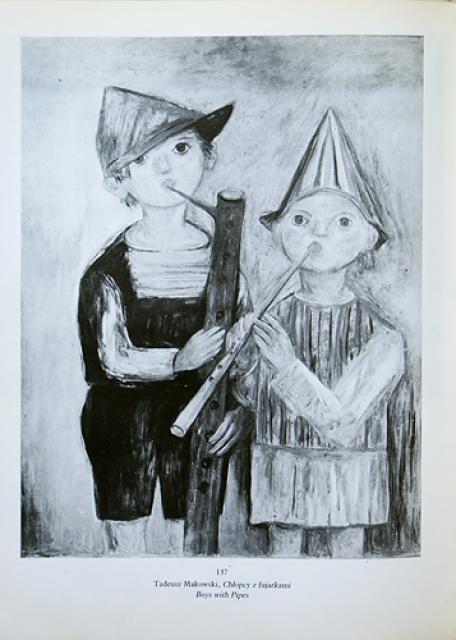
From 1918 onwards, children became the central protagonists of Makowski's paintings. In 1922, inspired by a small village concert, he created one of his most renowned masterpieces, "The Children's Chapel." The painting depicts a group of four children playing tunes before a tavern, surrounded by creatures such as a rooster, a canary, and a cat.
Makowski's depictions of children were not sentimentalized but instead conveyed a profound understanding and compassion. He portrayed their world through their own eyes, capturing their innocence and joy with authenticity and kindness. The painterly style of his works combined vibrant colors, simplified drawings, and generalized imagery, drawing inspiration from naive art forms.
Grotesque Transformations
In the late 1920s and early 1930s, Makowski's style underwent a transformation. While children remained central figures in his paintings, their depictions became more grotesque, resembling wooden puppets engaging in theatrical performances. Examples include "Masquerade" (1928), "The Little Family" (1928), and "Parade with a Lantern" (1931).
Despite this stylistic shift, Makowski's work retained its poetic lyricism and emotional depth. His untimely death cut short his artistic journey at the height of his talents.
Legacy and Preservation
After Makowski's passing, his friends and admirers established the "Society of Friends of Tadeusz Makowski." Their mission was to preserve and promote his artistic legacy. Throughout the 1930s, they organized solo exhibitions of Makowski's work in Paris, Venice, and Vienna. During World War II, they displayed enormous courage and effort to safeguard his paintings.
In 1954, Tadeusz Makowski's canvases made a triumphant return to Poland. Today, they occupy prominent places in museums and collections across the country, including Warsaw, Krakow, and Poznań. Makowski's art continues to be celebrated for its emotional sincerity, poetic beauty, and enduring relevance.


