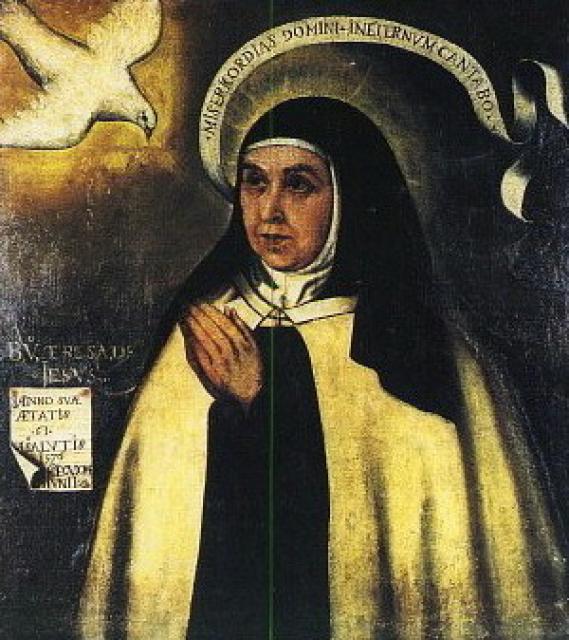
Teresa De Cartagena
 Spain
SpainBiography of Teresa de Cartagena
Teresa de Cartagena was a Spanish writer and nun who lived between 1453 and 1459. Her deafness during this period influenced the creation of her two most famous works, the essays 'Grove of the Infirm' and 'Wonder at the Works of God'. Teresa's last work is considered the first feminist treatise written by a Spanish woman. Little is known about Cartagena's life today. In Francisco Cantera Burgos' history 'Santa María family', the author confirms the existence of Teresa, who turns out to be a nun of the secular order from the Santa María family, one of the most powerful orders in late medieval Spain. Her grandfather, Rabbi Selomó ha-Levi, converted to Christianity around 1390 and was baptized under the name Pablo de Santa María, becoming the bishop of Burgos in 1412. Cantera Burgos discovered that Teresa was the daughter of Pedro de Cartagena. Before losing her hearing, she found herself in the Franciscan Monastery of Santa Clara around 1440, and later transferred to the Cistercian Monastery of Las Huelgas in 1449, where she eventually became deaf. This transition to another monastery was related, according to Yonsoo Kim's assumption, to the political strategies of the orders and the hostility shown by the Franciscans.
Teresa's Works and Influence
Teresa's first work, 'Grove of the Infirm', was written after she encountered loneliness that overwhelmed her due to her deafness. Approximately one or two years later, she defended her first essay with the work titled 'Wonder at the Works of God' when 'Grove of the Infirm' faced criticism, mainly from men who claimed that a woman could not be the author of such eloquent and well-motivated work. Both of her essays have reached modern readers through a single manuscript, completed by the scribe Pero López del Trigo in 1481.
Regardless of whether Teresa was the first feminist writer in Spain, she made a significant contribution to the European canon of medieval feminist authors, including Hildegard von Bingen and Christine de Pizan. 'Wonder at the Works of God' and 'Grove of the Infirm' are semi-autobiographical works that tell the true story of a medieval woman, which is a true rarity among medieval works. Teresa's first essay explores the influence of her deafness on her life and spiritual development. After the illness made itself known, Cartagena grapples with contemplation in the quiet prison of her deafness, eventually coming to the conclusion that God bestowed this affliction upon her to separate her from the mundane noise of everyday life.
Teresa's Response to Criticism
The scribe Pero López indicates that her work was sent to Juana de Mendoza, the wife of Gómez Manrique, a poet and prominent political figure of the time, because it was addressed to a 'virtuous lady', likely Mendoza. In reality, this 'virtuous lady' represented the entire female audience, which is why Teresa, in her wisdom, employed a strategy of self-deprecation before male readers, emphasizing the weakness of her intellect ('the mediocrity and rudeness of my feminine intelligence').
However, despite her excellent plan to disarm male readers, the stronger sex simply could not believe that 'Grove of the Infirm' was written by a woman, accusing Teresa of plagiarism. In response, Cartagena wrote 'Wonder at the Works of God', arguing that if God created men capable of writing, then He could also create women with the ability to write. She stated that just because men have been writing for centuries does not mean that it is exclusive to them due to their longevity in this pursuit. Furthermore, if women, according to custom, most often do not emerge as authors like men, it does not mean that women's works should sound inferior. Teresa claimed that if God bestows talents upon people, He can also endow women with writing abilities. She concluded that criticism from her opponents is an insult to God himself because they doubt His generosity.
In her essay 'Wonder at the Works of God', Teresa once again addresses the 'virtuous lady', illustrating her point of view through vivid imagery and references to the past. She hints at the (un)biblical story of Judith, a young Jewish widow who killed the military leader Holofernes, causing the Assyrians to panic and scatter without their leader.
In her essay, Teresa also presents the inner strength that a simple church servant can possess. According to her, the tranquility and spiritual peace within the female community, in contrast to the external world of perpetually warring men, contribute to an atmosphere of intellectual growth. Although Cartagena continues to acknowledge from a strategic standpoint that men and women are not equal in their abilities, she notes that they are essentially created to complement each other. Her subtle feminist arguments reject the prevalent belief that medieval women were the weaker sex, destined for inert lives by God, created solely for reproductive purposes.


