Theodor Blank
 Germany
- From Tradesman to Union Organizer
- Building a New Defense Ministry
- Labor and Social Policy
- A Founding Figure of the Federal Republic
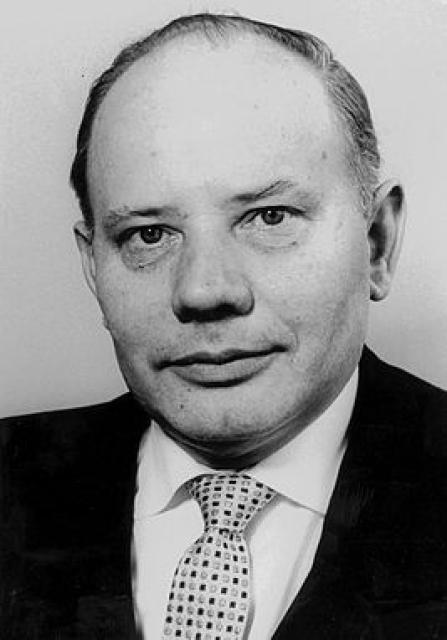
Theodor Blank helped steer West Germany through one of its most difficult postwar debates: whether, and how, the young democracy should build armed forces again. As head of the office that later became the Defense Ministry, he organized the early groundwork for the Bundeswehr. He became the Federal Republic’s first defense minister, then spent eight years overseeing labor and social policy.
From Tradesman to Union Organizer
Blank was born on September 19, 1905, in Elz, near Limburg, into a large Catholic family. After elementary and vocational school, he trained as a pattern maker and worked in industry. He entered the Christian labor movement in 1930, becoming a regional secretary for the Christian factory and transport workers’ union in the Ruhr area.
After the Nazi regime dismissed him from his union post in 1933, Blank completed his secondary education and studied mathematics and physics in Münster, then engineering in Hannover. He was drafted into the German armed forces in 1939 and spent the final months of the war as a prisoner. Returning in 1945, he joined the Christian Democratic Union as it formed in Westphalia and became active in local and regional politics.
Building a New Defense Ministry
Blank entered the first Bundestag in 1949. As Cold War tensions grew, Chancellor Konrad Adenauer appointed him in 1950 to handle questions connected with strengthening Allied forces in West Germany. His small government office, commonly called the “Amt Blank,” became the planning center for a future West German military contribution and the institutional predecessor of the Defense Ministry.
The work was politically contentious. Many Germans remained wary of remilitarization after the devastation of World War II, while the government argued that West Germany needed a role in European security. Blank helped organize plans, personnel, and structures for new forces intended to operate within a democratic state and alongside Western allies. When the office became the Federal Ministry of Defense in June 1955, he was appointed the first West German defense minister. In November that year, he presented appointment documents to the first 101 volunteer soldiers of the Bundeswehr.
The task was daunting: the new forces needed recruits, equipment, rules, and public legitimacy, all while the country’s postwar role remained under intense debate. Blank’s tenure ended in October 1956, after the founding laws for the Bundeswehr had been passed. He left the ministry to Franz Josef Strauss, but the basic administrative work of establishing the institution had already been done.
Labor and Social Policy
Blank returned to cabinet in 1957 as Federal Minister of Labor and Social Affairs, serving until 1965. His efforts to enact a broad “social package” met resistance from veterans’ organizations, physicians, and political opponents, earning him a reputation as a minister who struggled to get his reforms through. Yet the period also saw substantial pension increases, and legislation encouraged workers to build personal assets through savings and investment.
He remained active in the Bundestag and CDU leadership after leaving the cabinet, serving as a deputy parliamentary group leader and representing the party’s labor wing. As his health declined, he resigned his parliamentary mandate in April 1972. He died in Bonn on May 14, 1972, aged 66.
A Founding Figure of the Federal Republic
Blank’s legacy is tied to the institutions he helped create. The rapid organization of a West German military after the war was divisive, but the structures developed under his leadership helped embed the Bundeswehr within parliamentary government and democratic law. His later social-policy record was mixed: some reforms stalled, while pensions and worker savings advanced.
A former trade union official and craftsman, he moved into national politics at a moment when West Germany was redefining itself. His work linked two central tasks of the new republic: establishing its security role in the Cold War and shaping the social protections of its citizens.