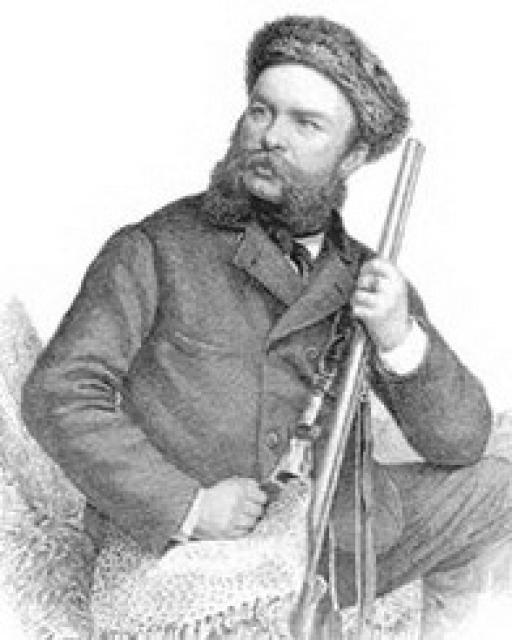
Theodor Heuglin
 Germany
- Theodor von Heuglin (1824-1876)
- Expeditions
- Sudan and the Red Sea (1856-1860)
- Abyssinia and the Nile Basin (1861)
- Arctic Explorations (1870-1871)
- Later Travels and Legacy
- Scientific Contributions
Theodor von Heuglin (1824-1876)
Early Life and EducationTheodor von Heuglin was born on March 20, 1824, in Hirschlanden, Germany. He studied natural history and pharmacy, laying the foundation for his future expeditions.
Expeditions
Europe and the Middle East (1850-1853)Heuglin embarked on his first major journey in 1850, visiting Egypt, Arabia, and the Red Sea. He accompanied the Austrian consul to Abyssinia, gaining valuable experience.
Sudan and the Red Sea (1856-1860)
In 1856, Heuglin explored the Bayuda Desert in Sudan and circumnavigated the western coast of the Red Sea and the Somali coast. He returned to Europe in 1860, cataloging his extensive collection of animals.
Abyssinia and the Nile Basin (1861)
Heuglin led an expedition in 1861 to search for the missing explorer Eduard Vogel. He reached the country of the Bilen people, becoming one of the first Europeans to do so. He later joined the expedition of the Dutch explorer Alexandrine Tinne, traveling along the Bar-el-Ghazal River and reaching the Kozanga (Djembo) River.
Arctic Explorations (1870-1871)
In 1870, Heuglin joined Count Waldburg-Zeil on an expedition to Svalbard (Spitsbergen), where he contributed to the mapping of its southeastern region. In 1871, he visited Novaya Zemlya, further expanding his Arctic experience.
Later Travels and Legacy
Red Sea and Cairo (1874)Heuglin's final expedition took him back to the Red Sea in 1874, where he explored the Beni Amer region. He spent time in Cairo before returning to Stuttgart, where he passed away on March 5, 1876.
Scientific Contributions
Heuglin's expeditions resulted in significant contributions to zoology and ornithology. He collected numerous animal specimens and wrote detailed accounts of his travels, providing valuable information on the flora and fauna of the regions he visited. His legacy as a naturalist and explorer continues to inspire scientists and travelers alike.