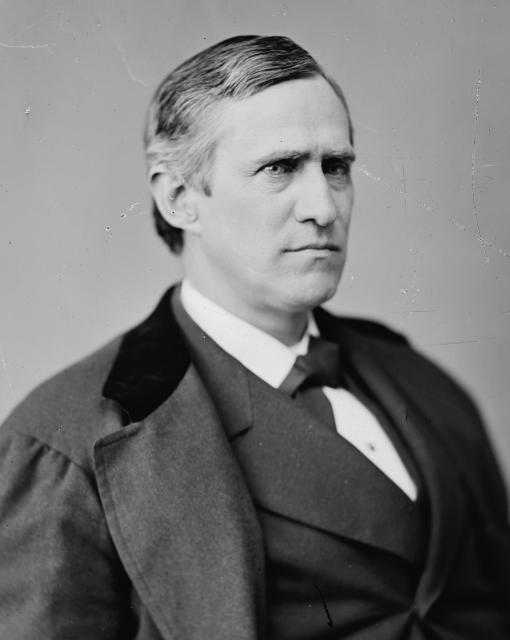
Thomas Francis Bayard
 USA
USABiography of Thomas Francis Bayard
Thomas Francis Bayard was an American lawyer and politician from Wilmington, Delaware. He was a member of the Democratic Party and served three terms as a United States Senator from Delaware. He also served as the U.S. Secretary of State and the U.S. Ambassador to the United Kingdom.
Early Life and Education
Thomas Francis Bayard was born on October 29, 1828, in Wilmington, Delaware. He was the son of Senator James A. Bayard, Jr. and Anne Francis, and the grandson of Senator James A. Bayard. The Bayard family was a wealthy and aristocratic family in Delaware, claiming their lineage from Richard Bassett and Augustine Herrman, the first lord of the manor. Bayard studied law and was admitted to the bar in 1851. He worked as an assistant to his father and served as the county prosecutor of Delaware from 1853 to 1854. He then practiced law in Philadelphia with his friend William Shippen until 1858, before returning to Wilmington. In 1856, Thomas married Louise Lee, who passed away in 1886. He later married Mary W. Clymer in 1889.
Political Career
As peace Democrats, both Thomas and his father vehemently opposed President Lincoln's coercive policies aimed at preventing the secession of the southern slave states. While their loyalty to the Union was questioned due to some of their actions, no direct evidence of treason was found. Thomas served as a major in the Delaware Guard. He was arrested for resistance when the Guard was finally disarmed but was later released on parole.
In 1868, Bayard was elected to the U.S. Senate, succeeding his father. He served in the Senate from March 4, 1869, to March 6, 1885. During his time, he held various positions, including President of the Senate, Chairman of the Finance Committee, and member of the Judiciary Committee and Committee on Revision of Laws. In 1876, Thomas was a candidate for President of the United States. He ran for president again as the Democratic Party candidate alongside Winfield Scott Hancock in 1880 and lost. In 1884, he conceded the presidency to Grover Cleveland. Bayard resigned from the U.S. Senate to become the U.S. Secretary of State under President Grover Cleveland's first administration. He served in this position from March 7, 1885, to March 6, 1889, gaining recognition for negotiating a treaty regulating fishing rights between the United States and Canada in the North Atlantic. Bayard also played a role in the resolution of the dispute between Great Britain and Germany over Samoa.
Later Years and Legacy
After four years in private practice, Thomas was appointed as the U.S. Ambassador to the United Kingdom during President Grover Cleveland's second administration. He served in this position from 1893 to 1897, becoming the first person to hold such an appointment. Although controversial, his tenure is sometimes credited with establishing strong ties between the United States and the United Kingdom. As an ambassador, Bayard criticized American protectionist trade policies, which he saw as "state socialism." Many considered him too partial to English customs, and he faced a vote of no confidence from the House of Representatives on November 7, 1895. Nevertheless, Bayard's diplomatic accomplishments were fully recognized in Great Britain, where he effectively defended the traditions of the famous line of American ministers.
Thomas F. Bayard passed away on September 28, 1898, at his daughter's home in Dedham, Massachusetts. He was buried at the Old Swedish Episcopal Church Cemetery in Wilmington. In his hometown, there is a Thomas F. Bayard Elementary School, and a statue was erected in his memory in Brandywine Park on Kentmere Parkway.


