Thomas Maldonado
 Italy
Italy- Biography of Tomás Maldonado
- The Ulm Concept
- Systems Approach to Design
- Contributions to Design and Publications
Biography of Tomás Maldonado
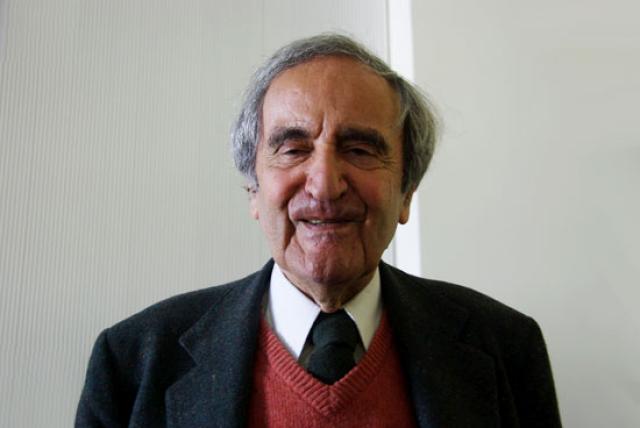
Tomás Maldonado is an Italian designer, painter, educator, author of articles and books on the theory of culture and design. Although originally from Argentina, he has been working in Europe since 1954. Since 1957, he has been the head of the Ulm School in Germany, which was founded by Max Bill in 1951. The school was specifically opened to train designers and served as a continuation of the ideas of the Bauhaus movement. It also became a model for other design education centers around the world.
The Ulm Concept
During his tenure as the rector of the Ulm School, Maldonado fully expressed his views on the possibilities and methods of design. The so-called Ulm concept focused on the theory of non-commercial design. According to this concept, designers should use scientifically grounded design methods, while their creations should have a humanistic orientation. As an educator at this school, Maldonado emphasized the integration of scientific and technical progress with aesthetics. He also sought to identify the unique characteristics of design as a social phenomenon and an active force that influences people's consciousness and the organization of the environment. In order to have an impact on society, designers must primarily utilize the capabilities of large-scale industry and align the goals of design accordingly. Therefore, the tactics of a designer's work involve mastering all the tools of influence - pragmatic, commercial, aesthetic - and subordinating them to the main cultural-humanistic goal.
Systems Approach to Design
Maldonado introduced and developed the principle of a systemic approach to design, exploring the relationship between design and science. He developed a theory of the complexity levels of the objects being designed, ranging from cups to helicopters and computers. In his practical work as a designer, Maldonado considered it necessary to widely use various mathematical disciplines, such as the theory of connections (in the field of aggregating machines from standardized units and coordinating modular dimensions), group theory (the theory of symmetry and control grids), curve theory (mathematical development of transitions and transformations), polyhedral geometry (construction of regular and irregular shapes), topology (metric and ametric construction of objects), and others.
Contributions to Design and Publications
Maldonado made significant contributions to the field of design graphics, particularly in the development of visual symbols for electronics. From 1976 to 1980, he served as the editor-in-chief of "Casabella," the largest Italian magazine on architecture and design. During these years, he published numerous articles on cultural issues and introduced methodologically focused sections in the magazine, promoting the creative convergence of architecture and design.