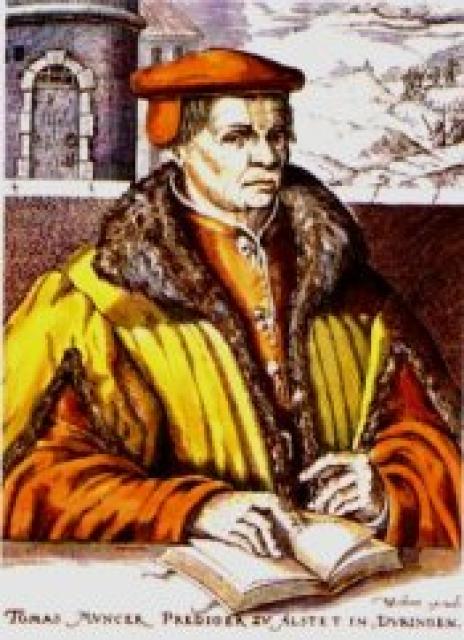
Thomas Meuntzer
 Germany
- Biography of Thomas Muntzer
- Early Life and Teachings
- Muntzer's Pamphlets and Teocratic "Communism"
- Muntzer's teocratic "communism" and the Peasants' Uprising
- Defeat and Execution
- Literature and Influence
Biography of Thomas Muntzer
Thomas Muntzer was a German revolutionary and ideologist of the popular movement during the Reformation. He was one of the leaders in the Peasants' War of 1524-1525 in Germany. Muntzer was a radical preacher during the Reformation and a spiritual leader of a social movement that preached universal equality based on evangelical ideals and advocated violence against the traditional church and nobility. The German peasant uprising of the 16th century was closely associated with Muntzer's movement.
Early Life and Teachings
Muntzer was born in Gartz in 1490. He studied in Wittenberg and became a priest. Like Luther, Muntzer was fascinated by mysticism, but he became captivated by the socio-religious unrest among the people and developed apocalyptic beliefs and communist visions. He began to reject external revelation and believed that only those who had experienced God in their hearts and souls were His true chosen ones. He argued that Scripture only kills, but does not bring life. According to Muntzer, rulers should serve the chosen ones of God, and those who do not submit to them should perish.
In 1520, Muntzer became a fiery demagogue and preacher in Zwickau, Saxony. His coarse language and Old Testament allegories resonated with the common people's beliefs. He was dismissed by the city council and traveled to Prague, where he attacked "priests and monkeys". Muntzer then arrived in Alstedt, Thuringia, where he gathered his former supporters and preached about establishing a "holy" kingdom on Earth. According to Muntzer, the "chosen people" or "Israel" should exterminate the wicked "Canaanites". Inspired by Muntzer, enthusiasts destroyed icons and burned churches, considering them "devil's caves". Muntzer also promoted social equality and envisioned a world where rulers would be equal to the lowliest Christian. In his letters to authorities and cities, Muntzer claimed that he was called by God to exterminate tyrants, asserting that the right to wield the sword belonged to communities, not princes.
Muntzer's Pamphlets and Teocratic "Communism"
Muntzer's pamphlets were signed with his name followed by the titles "Muntzer with the Hammer" and "Muntzer with Gideon's Sword". One of his pamphlets was dedicated to the "most illustrious, high-born Lord and almighty God Jesus Christ". He completely severed ties with Luther and his moderate, purely ecclesiastical reforms. Luther referred to Muntzer as the "Alstedt satan" while Muntzer called Luther the "Wittenberg pope", an arch-idolater, a flatterer of the princes who had only freed people's conscience from the Pope but held it captive in their own carnal desires.
Muntzer's teocratic "communism" and the Peasants' Uprising
After traveling through southern Germany and establishing connections with revolutionaries and leaders preparing for the peasant uprising, Muntzer settled again in central Germany, in the imperial city of Muhlhausen, at the end of 1524. Here, together with the former monk Pfeiffer, he led the common people and forced the wealthy burghers and city council to surrender. A new "eternal, Christian" council was elected, composed of the "poor" and "farmers". The city implemented communal ownership of property, and Muntzer seized monastic estates and captured castles and monasteries in neighboring lands.
In this new system, Muntzer did not hold a specific position but acted as a prophet and inspirer. He appeared before the people with a long beard, dressed in rich clothing, resembling the patriarchs. His preachings strongly condemned luxury, gold, and "idols in houses and chests". His main theme was the bloody extermination of all enemies of Christ. Soon, the peasants joined the radicalism of the city. The peasant uprising erupted in Thuringia simultaneously with the South German rebellion but had a distinctive feature, mainly expressed by Muntzer: a theocratic character influenced by the Czech Taborites and the use of Old Testament imagery.
Defeat and Execution
While the princes of central Germany gathered their military forces to suppress the Thuringian peasants and advanced towards the center of Muntzer's influence, he awaited the arrival of peasant reinforcements from Franconia and corresponded with the South. Eventually, he decided to confront the princely army at Frankenhausen, leading a force of around 8,000 peasants, mostly poorly armed and lacking cavalry. The peasants rejected Muntzer's demand to surrender, and he assured them that God would deflect the bullets from them. During the battle, which ended in a complete defeat for the peasants, Muntzer got lost and hid in the city but was eventually found, tortured, and beheaded.
Literature and Influence
Apart from the works related to the history of the Peasants' War, there are several biographies of Muntzer. Notable among them are Strobel's "Leben, Schriften und Lehren Th. Munzers" (1795), Seidemann's "Th. Munzer" (1842), and Merx's "Th. Munzer und Pfeiffer" (1889).
The most important Marxist work on Muntzer is Engels's "The German Peasants' War." Engels interpreted Muntzer as a fighter for social equality, using biblical language as the only means of communication understandable to the peasants of that time. However, critics argue that Muntzer's teachings were primarily driven by religious and apocalyptic motives, with little interest in achieving class justice.
In the 20th century, numerous works about Muntzer were created in the German Democratic Republic (GDR), where he was considered a national hero, and his portrait was depicted on banknotes.
This article is based on material from the Brockhaus and Efron Encyclopedic Dictionary (1890-1907).