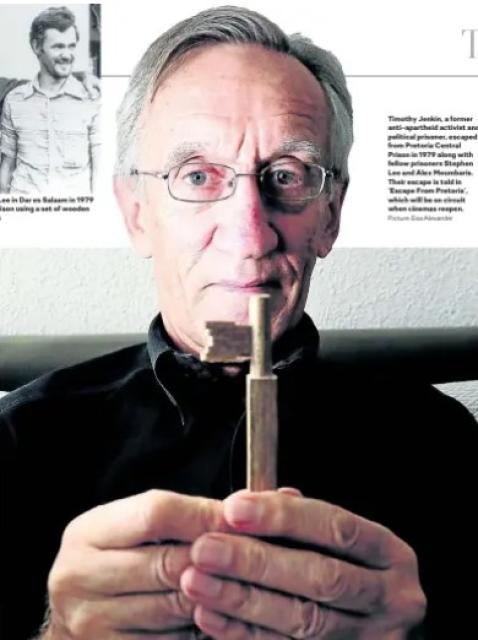
Tim Jenkin
 South Africa
- Birth and Early Life
- Social and Political Awakening in England
- Political Activism and Joining the ANC
- Imprisonment
- The Great Escape
- Life After Prison
- Return to South Africa and Post-Apartheid Career
- Legacy and Recognition
Birth and Early Life
Timothy Edgar Jenkins was born in Cape Town, South Africa. He attended Rondebosch Boys' Preparatory School and Rondebosch Boys' High School before entering university at age 17. After graduating, he dodged conscription into the South African Defense Force and worked in various jobs for two years, showing little interest in anything beyond motorcycle racing.
Social and Political Awakening in England
In 1970, Jenkins moved to the United Kingdom, where he discovered the injustices of the system while working in a fiberglass factory. This led him to pursue studies in sociology, which opened his eyes to the realities of apartheid in his home country. Jenkins realized that he had been a "normal, complacent white South African" who had "unthinkingly accepted the system and had never questioned it for twenty-one years."
Political Activism and Joining the ANC
In late 1970, Jenkins enrolled in the University of Cape Town (UCT) and obtained a Bachelor of Social Science degree in 1973. There, he met Steven Lee and became involved in anti-apartheid activities. They joined forces to distribute banned literature and raise awareness about the injustice faced by black South Africans.
In February 1974, Jenkins and Lee left South Africa to join the African National Congress (ANC) in London. After completing training, they returned to Cape Town in 1975 and began distributing propaganda leaflets using a bomb-leaflet device invented by Jenkins.
Imprisonment
On March 2, 1978, Jenkins and Lee were arrested for their anti-apartheid activities. They were held in Cape Town's notorious Caledon Square police station.
The Great Escape
During his imprisonment, Jenkins, Lee, and several other political prisoners planned a daring escape. They crafted wooden keys to unlock the prison doors, and Jenkins secretly brought a small amount of money into the jail. On December 11, 1979, they successfully escaped from the Pretoria Central Prison, leaving behind two prisoners whose sentences were nearing an end.
Life After Prison
Jenkins and Lee held a press conference in Lusaka, Zambia, in January 1980, before moving to London. Jenkins worked as a researcher for the International Defence and Aid Fund and later developed a cipher communication system for the ANC.
Return to South Africa and Post-Apartheid Career
Jenkins returned to South Africa in 1991 and played a role in the ANC's communications network. He held various positions within the ANC's media team and later became director of Unwembi Communications (Pty) Ltd.
In the late 1990s, Jenkins co-founded Community Exchange System (CES), a non-monetary exchange network for local communities. He also established Clearing Central, a second-tier exchange for CES groups.
Legacy and Recognition
Jenkins' contributions to the anti-apartheid movement and his innovative work in communications and community exchange systems have left a lasting legacy. His story and expertise have gained international recognition, including an invitation to speak at an event in the Netherlands in 2017.