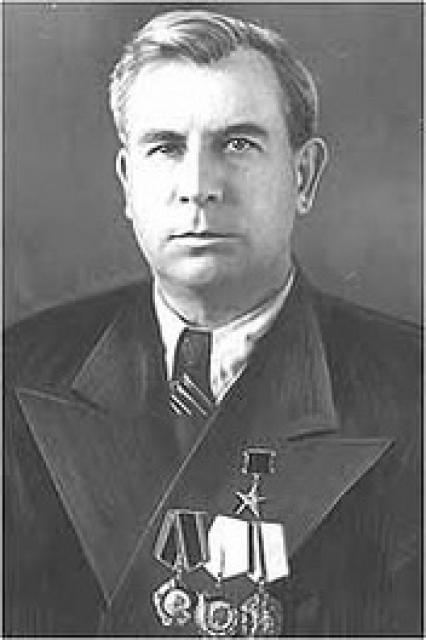
Timofey Gorbachev
- Early Life and Education
- Military Service and Engineering Career
- Management and Research Roles
- Academic and Administrative Leadership
- Research Contributions and Recognition
- Legacy
Early Life and Education
Mikhail Gorbachev, a prominent Soviet scientist in mining engineering, was born on June 23 (July 6), 1900, in the village of Troitskoye, now located in the Shatsk District of the Ryazan Region. Shortly after his birth, his family relocated to Chita, where he completed his secondary education at the local real school.
Military Service and Engineering Career
In 1919, Gorbachev participated in exploratory work for the construction of the Ayan-Nelkan Tract at the port of Ayan on the Okhotsk Sea coast. He also served in the Red Army during the Russian Civil War, fighting in the Zabaikalye region, the Irkutsk area, and in operations against General Pepelyayev's expedition in Yakutia in 1923.
In 1928, Gorbachev graduated from the Mining Faculty of the Tomsk Technological Institute (now University). He subsequently worked at various coal предприятий, holding positions such as superintendent of mining operations, designer, and chief project engineer. Concurrently, he taught at the Tomsk Technological Institute from 1931-1932.
Management and Research Roles
Beginning in 1933, Gorbachev served as chief engineer of the "Centralnaya" mine (Osinnikovsky Mine). In 1936, he became director of the Kuznetsk Scientific Research Coal Institute. From 1937-1942, he headed the technical department of the "Kuzbassugol" combine.
During World War II, Gorbachev held key engineering roles at the "Kemerovougol" and "Osinnikiugol" trusts from 1942-1943. From 1946-1959, he served as chief engineer of the "Kuzbassugol" combine, where he played a crucial part in developing and implementing innovative coal mining technologies. Notably, he collaborated with V. Vorobyov, I. Patrushev, and F. Kufafyov to create mechanized movable supports. In 1947-1948, they designed and tested the world's first moving face cutter "Kuzbass-1" with a movable hydraulic support.
Academic and Administrative Leadership
In 1950-1954, Gorbachev served as rector of the Kemerovo Mining Institute. In 1951, he became a professor. From 1954, he chaired the West Siberian Branch of the USSR Academy of Sciences (Novosibirsk). In 1958-1971, he was deputy chairman of the newly created Siberian Branch of the USSR Academy of Sciences.
Gorbachev established and headed the laboratory of rock pressure at the Institute of Geodynamics, Siberian Branch of the USSR Academy of Sciences (Novosibirsk) from 1958 until his retirement in 1972. He also chaired the Scientific Council on Rock Mechanics and Rock Pressure Problems at the Siberian Branch of the USSR Academy of Sciences from 1960-1973.
Research Contributions and Recognition
In 1944, Gorbachev earned his candidate's degree (equivalent to a PhD). He authored over 70 scientific papers and held 15 inventions related to the development of powerful steeply dipping coal seams, geomechanics, and equipment for the mechanization of mining operations. Notably, he co-authored the comprehensive work "Development of Coal Deposits in Kuzbass" (1959).
From 1965, Gorbachev served as editor-in-chief of the scientific journal "Physico-Technical Problems of Mining," which he initiated. He also edited the work "Rock Pressure on Powerful Steep Seams" (1967).
Gorbachev received numerous awards for his contributions, including the Stalin Prize (1949), three Orders of Lenin, the Order of the Red Banner of Labour, the Order of the Badge of Honour, and the "Miner's Glory" badge of both the 1st and 2nd degrees.
Legacy
Mikhail Gorbachev died on December 20, 1973, and was laid to rest in the Yuzhnoye (Cherbuzin) Cemetery in Novosibirsk. His significant contributions to mining engineering and geomechanics continue to shape the field's development to this day.


