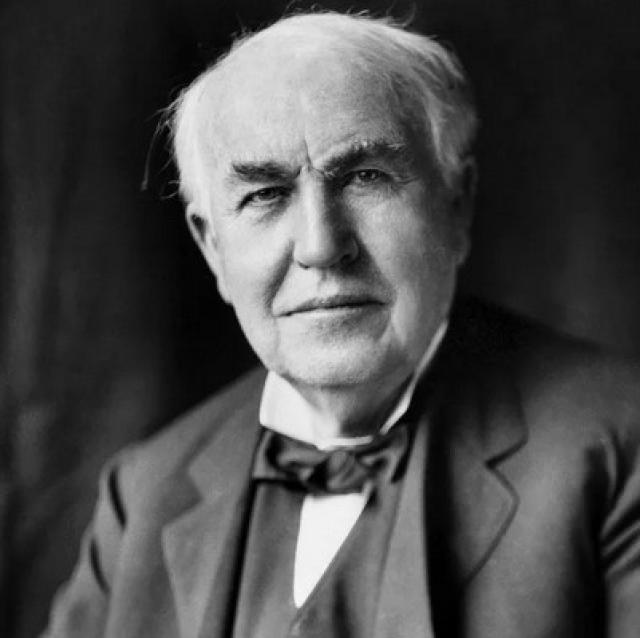
Tomas Edison
 USA
USA- Thomas Edison: American Inventor and Entrepreneur
- Early Life and Influences
- The Menlo Park Laboratory
- The Birth of the Phonograph
- The Development of the Light Bulb
- Edison's Business Acumen
- The War of Currents
- Legacy and Impact
Thomas Edison: American Inventor and Entrepreneur
Born in Milan, Ohio, and raised in Port Huron, Michigan, Thomas Edison was an American inventor and entrepreneur. Regarded as one of the most prolific inventors in history, his creations have significantly shaped the modern world.
Early Life and Influences
Despite initial academic struggles, Edison's curiosity and passion for experimentation led him to pursue a career in telegraphy. An incident where he saved a child from a train earned him a job as a telegraph operator, where he honed his skills and experimented during night shifts.
The Menlo Park Laboratory
Founding his research laboratory in Menlo Park, New Jersey, in 1876, Edison embarked on a path of groundbreaking inventions. His success in selling the quadruplex telegraph to Western Union for $10,000 funded the establishment of this state-of-the-art facility, where he and his team worked diligently to develop new technologies.
The Birth of the Phonograph
In 1877, Edison introduced the phonograph, a device capable of recording and reproducing sound. Despite its limitations, it brought Edison international fame and solidified his reputation as a genius.
The Development of the Light Bulb
Edison's most iconic invention remains the light bulb. While he did not originate the concept, he perfected the incandescent bulb through extensive experimentation and patenting his design in 1880. This innovation revolutionized lighting and laid the foundation for the electrical grid.
Edison's Business Acumen
Edison was not only an inventor but also a shrewd businessman. He understood the importance of intellectual property rights and mass production in maximizing profits. His establishment of the Edison Illuminating Company in 1880 and the Pearl Street Generating Station in 1882 brought electric power to New York City and beyond.
The War of Currents
Edison's rivalry with George Westinghouse over the type of electrical current to be used in the power grid led to the "War of Currents." Edison advocated for direct current (DC), while Westinghouse championed alternating current (AC). Ultimately, AC became the dominant choice for long-distance power transmission.
Legacy and Impact
Edison remained active in business and innovation until his death from complications of diabetes in 1931. His prolific inventions, including improvements in the telegraph, telephone, motion picture, and sound recording, continue to shape our lives today. His legacy as an American icon and a symbol of scientific ingenuity remains unparalleled.


