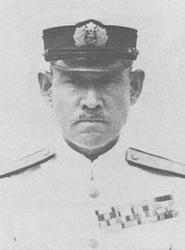
Tomas Kinkeyd
 USA
USABiography of Admiral Thomas Cassin Kinkaid
Admiral Thomas Cassin Kinkaid (3.4.1888, Hanover, New Hampshire - 17.11.1972, Bethesda, Maryland) was an American naval officer. He was born on April 3, 1888 in Hanover, New Hampshire. Kinkaid received his education at the United States Naval Academy in Annapolis, graduating in 1908.
Early Career
After graduating from the Naval Academy, Kinkaid served in the United States Navy, specializing in naval artillery. In 1932, he served as a technical advisor at the Geneva Disarmament Conference. He later served as a naval attaché in Rome and Belgrade.
World War II
After the bombing of Pearl Harbor in 1941, Kinkaid was transferred to Hawaii and took command of the 6th Cruiser Division. He carried out several raids against the Japanese in the Gilbert Islands. During the Battle of Coral Sea, he commanded a squadron consisting of the heavy cruisers "Minneapolis" and "New Orleans," as well as four destroyer escorts for the aircraft carrier "Lexington." He played a significant role in the Battle of Midway and the landing on Guadalcanal on August 7, 1942.
From September 1942 to May 1943, Kinkaid commanded the 16th Task Force, which included the aircraft carriers "Hornet" and "Yorktown." He participated in the Battle of Santa Cruz Islands on October 26-27, 1942, where the "Hornet" was lost and the "Enterprise" suffered heavy damage (although the Japanese naval aviation also suffered significant losses). From November 1942 to May 1943, he served as the Commander-in-Chief of the United States Navy in the North Pacific.
In 1943, Kinkaid commanded the 67th Task Force, and later a cruiser squadron. He initiated the retraining of crews for night operations, disrupting the Japanese system of nighttime supplies on the Pacific islands. During the Aleutian Islands campaign, he commanded the Northern Forces of the United States Navy. In November 1944, he was appointed Commander of the U.S. 7th Fleet, which consisted of converted aircraft carriers.
Later Career and Retirement
On October 24-25, 1944, Kinkaid led an operation to deliver parts of the 6th American Army to the island of Leyte. During the Battle of Leyte Gulf, he was attacked by the Japanese fleet under Admiral Kurita due to mistakes made by Admiral William Halsey. However, Kinkaid was able to repel the Japanese attack with his aircraft, forcing them to abort the operation as they awaited the arrival of the larger U.S. fleet.
He then oversaw troop deployments to the Philippines (where he lost 27 ships) and Borneo (losing 3 ships). After the war, Kinkaid commanded forces on the Eastern Naval Frontier. He retired on May 30, 1950.
Admiral Thomas Cassin Kinkaid passed away on November 17, 1972, in Bethesda, Maryland. He is remembered as a highly respected and influential naval leader during World War II.