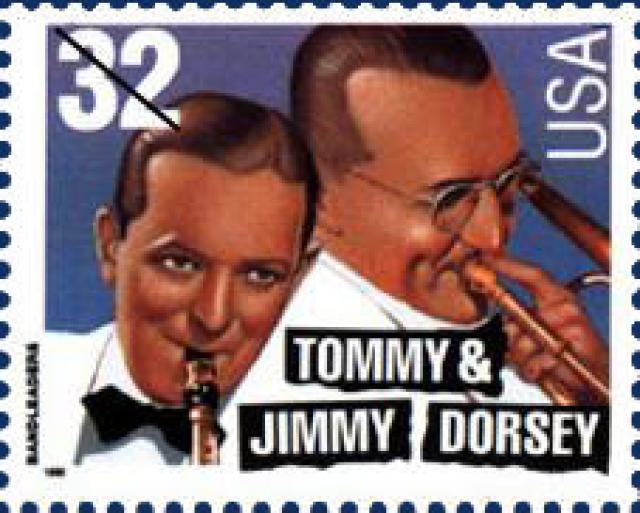
Tommy Dorsey
 USA
USABiography of Tommy Dorsey
Tommy Dorsey was an American jazz musician, trombonist, trumpeter, band leader, and ensemble conductor. He was born on November 19, 1905, in Shenandoah, Pennsylvania. He began studying music at a young age under the guidance of his father, a cornetist and leader of a brass band. With his father's help, he learned to play the trumpet and later switched to the trombone.
At the age of 16, Tommy Dorsey got his first engagement in the SCRANTON SIRENS ensemble, where his brother Jimmy Dorsey also performed. He then played together with his brother in the Ed Kirkeby's orchestra CALIFORNIA RAMBLERS and participated in their recordings in New York. He collaborated with Jean Goldkette and Paul Whiteman, who led large symphonic jazz orchestras with dance and entertainment repertoire until 1927.
In 1925, Tommy Dorsey recorded as a trumpeter. Like his brother Jimmy Dorsey, he was a member of the studio dixieland ensemble "Red" Nichols' FIVE PENNIES (1926), which also included Benny Goodman, Joe Venuti, Eddie Lang, and Gene Krupa. From 1927, he specialized in playing the trombone. Due to the instability of his financial situation, he occasionally worked in various commercial orchestras such as Vincent Lopez, Ted Lewis, Andre Kostelanetz, Victor Young, Rudy Vallée, and in 1928 and 1932, in Phil Napoleon's ORIGINAL MEMPHIS FIVE ensemble (together with his brother).
In the same year, he founded and led the DORSEY BROTHERS ORCHESTRA together with his brother Jimmy Dorsey, which gained wide recognition. In 1935, Tommy Dorsey formed his own big band. The success of his big band was largely due to the arrangers Paul Weston, D. Kinkaid, S. Oliver, and Bill Finegan. In 1936, following the example of the small dixieland band ORIGINAL DORSEYLAND ORCHESTRA led by Jimmy Dorsey, Tommy Dorsey formed the CLAMBAKE SEVEN combo from members of his big band. The combo specialized in improvisational chamber jazz in a traditional style and was intended for jam sessions.
In 1953, the Dorsey brothers reunited. Jimmy Dorsey disbanded his orchestra and began working as a soloist (and co-leader) of Tommy Dorsey's big band. After Tommy Dorsey's death, Jimmy Dorsey continued to lead the band (from 1956-57). The orchestra remained popular in the following years (partly due to radio and television) and became a "memorial" band, constantly renewing its lineup until the 1960s (under the leadership of Lee Castle and later Warren Covington).
Tommy Dorsey played an exceptional and important role among the leading "white" musicians of the swing era. While primarily representing commercial dance and entertainment popular music, he made a significant contribution to bridging the gap between this sphere and jazz, and in the development of a professionally mature concert style of swing orchestra. Benny Goodman is one of his most significant successors in this direction. This tendency can be conditionally referred to as "jazz-in-swing" (the assimilation of jazz idiomatics in the field of commercial swing), while the term "swing-in-jazz" (the development of swing techniques in jazz) is more applicable to Negro hot swing (which emerged in the early 1920s). Without being a revolutionary or radical experimenter in the field of swing, Dorsey, however, rightfully ranks among the founders of the classic swing style. He succeeded in bringing together and implementing a combination of the most significant stylistic ideas from the previous historical period of jazz in a limited, well-balanced, and technically perfect form. He also enriched American popular music with these ideas, making them accessible to a wide mass audience.
In addition to his achievements in swing music, Tommy Dorsey played a significant role in popularizing the big band variations of boogie-woogie in a specifically swing interpretation. He was one of the pioneers of this direction (big band boogie, boogie-in-swing) along with Bob Crosby and "Count" Basie. He also composed a number of compositions and arrangements in the boogie-swing style. As one of the first (among white band leaders), he made solo improvisations an essential part of the big band. He encouraged vocalists performing with him to incorporate elements of improvisation in their performances, such as scat singing. He included individual numbers with artificially constructed comedic syllabic combinations (known as nonsense songs) in his repertoire.
Tommy Dorsey worked with smaller combos, mainly in the realm of dixieland jazz (introducing swing elements into it). As a trombonist, he was influenced by Miff Mole and gradually developed his own individual performance style. His style was technically proficient, characterized by elegance, graceful melodic lines, pure intonation, smooth legato sound (in the style of sweet and cool jazz), a preference for high registers, and a more agile and fluid improvisational playing style. He rarely used glissandos and growl effects, which were characteristic of African American jazz musicians. In the 1930s, he earned the nickname "The Sentimental Gentleman of Swing." He influenced some contemporary trombonists, such as Urbie Green.


