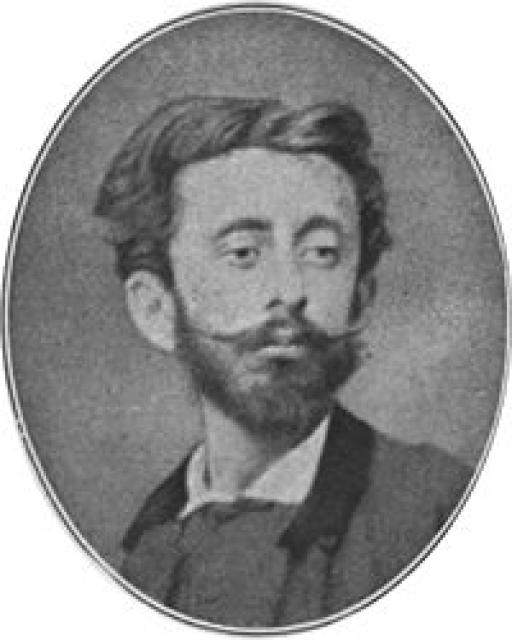
Tristan Corbiere
 France
Biography of Tristan Corbière
Born on July 18, 1845, in the small seaside town of Morlaix, Brittany, Tristan Corbière was a French symbolist poet and a representative of the group known as the "cursed poets." His father, Jean Antoine Edouard Corbière Sr., was a fearless and free-spirited sea captain, a romantic outcast and a Voltairian. He traveled extensively, chronicling his adventures in various French journals. However, tired of his wanderings, he settled in the small town of Morlaix, where he married Tristan's future mother, Angélique Corbière Puio, who was 33 years younger than him. They had three children, with Tristan being the eldest.
Early Life and Education
Tristan spent his childhood in Lannion, near Morlaix. At the age of 14, his parents decided to send him to the Imperial Boarding School of Saint-Brieuc. However, his successful studies were interrupted by rheumatism, which soon developed into consumption, making it impossible for him to continue his education. He was forced to move in with his uncle, a doctor who had his own house in Nantes. There, he attended the local school, but after two years, his illness forced him to once again interrupt his studies.
To alleviate his suffering, Corbière embarked on a journey to warmer seas. However, it did not bring any visible improvements to his health. Desperate, he decided to settle on the ocean shore in the town of Roscoff, where his father owned a small house. Here, he often went out to sea on his father's yacht, "The Slaveship," named after his father's most popular novel. It was in Roscoff that Corbière began to paint and write his first poems. The locals called him "An Anku" in Breton, which literally means "The Death Ghost." He himself admitted that he was ugly and somewhat frightening, with a thin body, tall stature, and disheveled hair. He considered himself insignificant, ill-suited for life, and destined for reading and creativity. Out of despair, he formed friendships with some French poets who frequently vacationed in Roscoff. With one of them, he embarked on a long journey through Italy. There, he met Count Rodolfo de Battino and his lover, the Italian actress Armida-Giuseppina Cucchiari, who performed under the stage name Erminia but whom Corbière always called Marcelle.
Influence of Love and Literary Career
Corbière fell in love with Cucchiari, and this love would shape his future literary career. Unable to bear the separation from her, he moved to Paris. However, their relationship did not work out, and the Italian actress left the sick poet. In 1873, Corbière published his only book, "Yellow Love," with the financial support of his father. It went unnoticed in Paris, and Tristan returned to Brittany. Here, he attempted to compose poems again, but he struggled to produce anything of significance. On March 1, 1875, Edouard Joachim Corbière died of consumption under the roof of his own house.
"Curved Love" was a book of grotesque and ironic poetry, the only book by Corbière, published in 1873. The title of the collection was derived from French idioms: "yellow rage," meaning intense fury, and "yellow smile," which refers to a tired, forced smile. The book contained almost all of Corbière's written works, except for a few youthful poems and twelve poems that were discovered and published posthumously. The original edition of the book was accompanied by a dedication to "The Slaveship" (1832), his father's most famous novel. In 1891, the book was reissued in the same configuration.
In August 1883, the Parisian literary weekly "La Lutèce" published an essay by Paul Verlaine dedicated to Corbière's work. These articles became the first in the collection of "Articles on the Cursed Poets." "Curved Love" had a profound influence on Thomas Eliot. Corbière's poems were translated into Russian by Innokenti Annensky, Ivan Tkhorevsky, Sergei Bobrov, Benedict Livshits, and others.




