Tupak Amaru
 Peru
PeruBiography of Tupac Amaru
Tupac Amaru was the last ruler of the Inca people in Peru. He was the son of Titu Cusi Yupanqui, also known as Manko Kapak II, and served as a priest and caretaker of his father's body. After his brother, Sapa Inca (Titu Cusi), died in 1571, Tupac Amaru became the ruler of the Inca Empire.
Rumors spread among the Inca people that Spanish priests, whom Titu Cusi had welcomed in Vilcabamba, had poisoned him. The priests were captured and executed, and the Inca occupied the border territories between Peru and the Spanish dominions. At that time, the Spaniards were unaware of the death of the previous Sapa Inca and sent two envoys for negotiations. Both envoys were killed by one of the Inca commanders. Using this as a pretext for war, Vice-King Francisco de Toledo, Count of Oropesa, decided to attack the Inca and seize Vilcabamba. He declared war on April 14, 1572.
Within two weeks, a small group of Spanish soldiers captured a key bridge on the border, marking the beginning of the invasion. On June 1, the first battle took place in the Vilcabamba Valley. Despite being poorly armed, the Inca were determined to win. They launched the first attack but were forced to retreat. On June 23, Fort Guayana Pucara caught fire as a result of artillery bombardment. The Inca army was forced to abandon their last city and retreat to the jungle. On June 24, the Spanish entered Vilcabamba but found it deserted. Sapa Inca had disappeared, the city was completely destroyed, and the Inca Empire officially ceased to exist.
The day before this, Tupac Amaru and a hundred warriors headed west into the jungle. His group, consisting of military leaders and family members, divided into smaller groups to avoid capture. Three groups of Spanish soldiers pursued them. One group captured the son and wife of Titu Cusi. The second group returned with prisoners and seized gold, silver, and precious stones. The third group captured two of Tupac Amaru's brothers, other family members, and several military leaders. Sapa Inca and his commander-in-chief remained free.
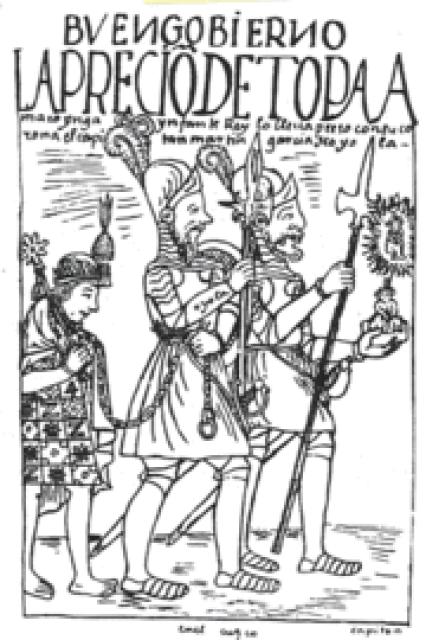
After these events, the Spaniards formed a squad of 40 elite soldiers to search for Tupac Amaru. They crossed the Masahua River and, after traveling 170 miles, discovered an Inca depot with a large quantity of gold and tableware for the imperial table. The Spaniards captured a group of Chunko Indians who informed them that they had seen Sapa Inca. The Spaniards learned that Tupac Amaru had descended the river in a boat to a place called Momori. They tied rafts together and followed him. In Momori, they discovered that Tupac Amaru had moved on. The Spaniards enlisted the help of local Indians who showed them the way and informed them that Tupac Amaru had stayed in their lands due to his wife's childbirth. After covering 50 miles, the pursuers saw a campfire. They found Sapa Inca Tupac Amaru and his wife by the fire. The Spaniards guaranteed the safety of Tupac Amaru and his wife, but he was arrested.
The prisoners were taken to the ruins of Vilcabamba and then brought to Cusco along with other captured Indians on September 21. The victors also seized the mummified bodies of Manko Kapak and Titu Cusi, the golden statue of Punchao, and other relics, including the remains of the hearts of deceased Sapa Incas. They were later destroyed. The priests attempted to convert Tupac Amaru to Christianity, but he rejected their offers, prepared to meet his fate. Five of the captured Inca military leaders were put on trial, but no one spoke in their defense. They were sentenced to hanging. The bodies of those who died earlier from torture were also hanged.
The trial of Sapa Inca began a few days later. Tupac Amaru was accused of killing the priests in Vilcabamba, a crime he likely had no involvement in. Tupac Amaru was sentenced to death. Numerous sources report that many Catholic priests, believing in Tupac Amaru's innocence, pleaded on their knees to spare his life, arguing that the Inca was sent to Spain for a trial, not execution. There is a belief that the execution of Tupac Amaru in 1571 tarnished the reputation of Vice-King Toledo. However, there are opposing views suggesting that Tupac Amaru participated in the uprising and that Francisco de Toledo attempted peaceful resolution of the disagreements, with three of his envoys to the Inca being killed, and that Tupac Amaru subsequently led the resistance against the colonial army. From these perspectives, the execution of Tupac Amaru is not seen as an unjust or wrong decision. King Philip II of Spain, nevertheless, condemned the execution.
Witnesses reported seeing him on the day of the execution, riding a mule with his hands tied behind his back and a noose around his neck. Other witnesses mentioned a large crowd, and hundreds of people guarded Sapa Inca with spears. In front of the main cathedral in the central square of Cusco, a scaffold draped in black fabric was set up. Sources mention that between 10,000 to 15,000 people attended the execution.
Tupac Amaru ascended the scaffold accompanied by the bishop of Cusco. Witnesses reported, "The multitude of Indians who filled the square watched this sad spectacle [and knew] that their ruler and Inca must die, and they appealed to the heavens, but their cries and lamentations were stifled." (Murúa 271)
According to reports by Baltazar de Ocampo and Gabriel de Oviedo, a Dominican monk from Cusco, both of whom witnessed Sapa Inca raising his hands to silence the crowd, his last words were:
"Ccollanan Pachacamac ricuy auccacunac yahuarniy hichascancuta."
"Mother Earth, witness how my enemies spill my blood."
The conquest of Peru continued for about forty years, from the execution of Emperor Atahualpa to the execution of his nephew. The Spanish viceroys exiled all descendants of the Inca rulers. Several dozen of them, including Tupac Amaru's three-year-old son, were sent to Mexico, Chile, Panama, and other colonies. Some of them returned, and Tupac Amaru's great-grandson, Tupac Amaru II, led the indigenous uprising against Spanish presence in Peru in 1780.