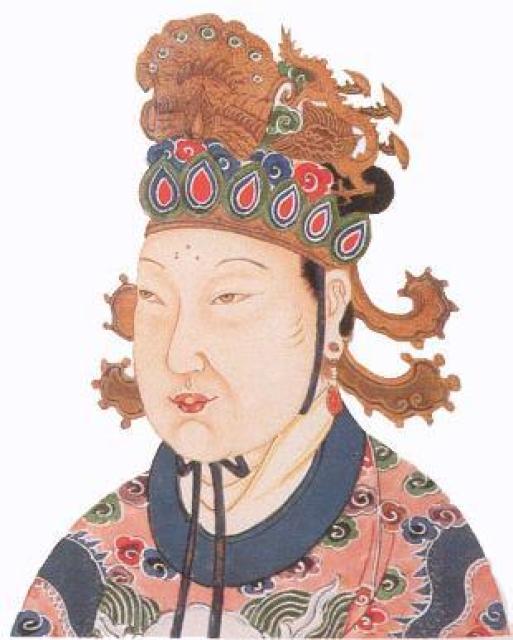
U Hou
 China
ChinaBiography of Empress Wu Hou
Empress Wu Hou was the concubine of the Chinese Emperor Taizong. She effectively ruled China for forty years from 665 AD until her death. In 690 AD, she officially took the title of Empress Wu Zetian, becoming the first and only woman to solely rule China. Her reign interrupted the Tang Dynasty and marked the beginning of the Zhou Dynasty.
Early Life and Rise to Power
At the age of 13, Wu Hou entered the harem of the powerful Emperor Taizong as a junior concubine. Little is known about her life in the harem. Following Taizong's death in 649 AD, she was sent to a Buddhist temple, as was the custom at that time, to spend her remaining days as a nun with a shaved head. However, even in the monastery, she maintained her connection with Taizong's son and heir, Emperor Gaozong. Eventually, Gaozong took her out of the monastery and into his own harem. Over the next two to three years, she eliminated all her rivals, including the emperor's wife, using various schemes.
In 655 AD, Wu became the empress and gave birth to four sons and a daughter for Gaozong. Her elevation to power offended Taizong's companions and the highest aristocracy, who considered her a commoner. According to the beliefs of that time, intimate relationships with both the father and then the son were considered incestuous. In her covert struggle, Empress Wu emerged victorious, eliminating all her enemies by 660 AD.
Rule as Empress
Gaozong's declining health, both physically and mentally, resulted in Empress Wu effectively ruling the country for the last 23 years of his life. She personally selected military commanders to lead wars on the Korean Peninsula, and due to her insight and energy, Korea was conquered by the Tang Empire by 675 AD. During her rule, Buddhism's influence in the country greatly increased. She ruthlessly dealt with anyone who showed disobedience, instilling fear and reverence among the courtiers.
After Gaozong's death in 683 AD, Empress Wu passed the throne to her eldest son, Zhongzong. However, noticing his helplessness and submission to his young wife, she deposed them both after just a month and placed another son, Ruizong, on the throne. This turn of events sparked protests from Tang loyalists, but the rebellion they raised in the south was brutally crushed by the empress. By 690 AD, Wu's position was so secure that she dethroned her son and proclaimed herself Emperor, an unprecedented event in Chinese history.
Later Years and Overthrow
Although the western and northern borders of the Tang Empire faced constant threats from nomadic tribes, Empress Wu was forced to focus on issues of succession. Members of her own family, who were close to the throne, saw themselves as the rightful heirs after the establishment of the Zhou Dynasty. After much deliberation, in 698 AD, the empress recalled Zhongzong from exile and designated him as the future emperor. She dealt with members of her own family as harshly as she did with others.
In her final years, starting from 699 AD, the empress's prudence was compromised by the onset of senile debauchery. She formed close relationships with two brothers from the Zhang family, who had questionable reputations, and they became her lovers. Despite the warnings of the courtiers, the aging ruler relied entirely on the loyalty of the Zhang brothers. In February 705 AD, a group of conspirators among the highest officials seized the palace, executed the Zhang brothers, and sent the empress to live out her final days in a country estate. Zhongzong was declared the emperor.


