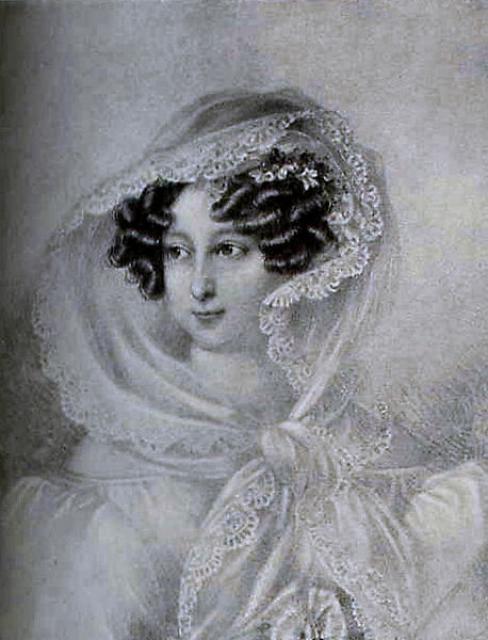
Wilhelmina Sagan
 Austria
Biography of Wilhelmina Sagan
Wilhelmina Sagan was a renowned society lady and the mistress of Metternich, the older sister of Dorothea, Duchess of Sagan, and the lover of Talleyrand. She was the eldest daughter of Peter von Biron, Duke of Courland, and his third wife, Dorothea von Medem. She spent her early childhood in Mitau before her father was forced to abdicate the Duchy of Courland. The family then moved to the Duchy of Sagan in Silesia, which was purchased in 1786. Her father also acquired the county of Nachod in Bohemia, including the Ratiborzhice Castle. Wilhelmina later chose this castle as her summer residence.
Wilhelmina was beautiful and well-educated, studying history and philosophy. She fell in love with her mother's lover, Swedish General Gustav Armfelt. Their secret affair, despite Armfelt being much older and married, led to Wilhelmina giving birth to a daughter named Gustava in Hamburg in 1800. The childbirth was difficult, and due to the incompetence of the midwife, Wilhelmina was unable to have any more children. Gustava was given to her father's relatives in Sweden, and Wilhelmina never saw her daughter again. In the future, Wilhelmina regretted this decision. To protect her lover's reputation, the general arranged for her to marry French aristocrat Prince Jules de Rohan-Guemene in 1800. The marriage was unsuccessful and ended in divorce in 1805.
In 1800, there were talks of Wilhelmina's engagement to Arkady Suvorov, the son of General Suvorov, but the wedding did not take place. After the death of General Suvorov, the plans for the marriage were postponed and eventually fell through.
Wilhelmina spent the rest of her life between Vienna, Prague, Ratiborzhice, and Sagan. She also traveled to Italy, England, and France. Her second marriage to Prince Vasily Trubetskoy ended in divorce in 1805-1806. In Vienna, she held a salon where the aristocracy gathered. Being an attractive woman, she captivated many noblemen. She had a romance with Prince Alfred Windischgrätz, an Austrian general. However, her relationship with Metternich, whom she had known for a long time, began in the spring of 1813. Their passionate love affair is evidenced by over 600 letters that also describe the political situation and Metternich's governmental decisions. Prior to their relationship, Metternich had a romance with Bagration's wife, Catherine Skavronska, who gave birth to their daughter Clementine in 1810.
Modern historians suggest that Wilhelmina, who hated Napoleon, may have influenced Metternich's cautious pro-French policy. For instance, the negotiations of the 1813 anti-Napoleonic coalition between Prussia, Austria, and Russia took place at Ratiborzhice Castle. Princess Bagration also "remembered with pleasure that she persuaded Metternich to agree to Austria's participation in the anti-Napoleonic coalition." The peak of Wilhelmina and Metternich's relationship occurred during the Vienna Congress, where Catherine Bagration, the "Russian Andromeda," competed with Wilhelmina, the "Cleopatra of Courland," for the favor of Alexander I. Both lionesses settled in the luxurious Palais Palm, occupying their respective halves. The resulting "love square" attracted considerable attention.
After the Vienna Congress, Metternich's relationship with Wilhelmina ended as she "decided to marry Metternich herself and lost. The count remained faithful to his family and Eleanor (his wife)." In 1818, she married Count Carl Rudolf von der Schulenburg, but this marriage also ended in divorce.
Without any children of her own, Wilhelmina became a foster mother to many young girls. Božena Němcová, the famous Czech writer, enjoyed her special patronage. According to official documents, Božena's mother was a housekeeper in the duchess's household, leading to suspicions that she was an illegitimate daughter, possibly of Wilhelmina and Metternich or Count Karel Clam-Martinic or Windischgrätz. Another version suggests that Božena may have been Wilhelmina's niece, the daughter of her sister Dorothea and Count Karel Clam-Martinic.
In her novel "Babička" (Grandmother), Božena Němcová portrayed Wilhelmina as the ideal woman. This image was so touching that in Czech culture, the expression "paní kněžna" (the lady princess) came to refer specifically to Wilhelmina.
Wilhelmina passed away in 1839 without any legitimate offspring, and her estate went to her sister Pauline. The sisters were buried in Kreutzkirche in Sagan.


