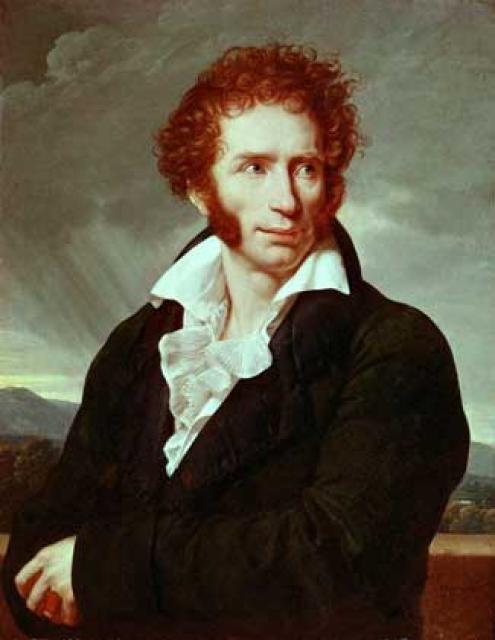
Ugo (Nikkolo) Foscolo
 Italy
Italy- Early Life and Education
- Military Service and Literary Pursuits
- - In his spare time, he engaged in criticism and journalism.
- - In 1816, he settled in England.
- - He achieved fame with two notable works:
Early Life and Education
- Ugo Foscolo, an Italian writer and philologist, was born on February 6, 1778, on the island of Zakynthos in Greece.
- After his father's death, Foscolo moved to Venice in 1792 and received a comprehensive literary education.
- He embraced liberal ideas, which he expressed in his tragedy "Tieste" (performed in 1797), inspired by the works of Vittorio Alfieri.
Military Service and Literary Pursuits
- During the Napoleonic Wars, Foscolo served extensively in the military.
- He forged close relationships with renowned literary figures in northern Italy, including Giuseppe Parini and Vincenzo Monti.
- In his spare time, he engaged in criticism and journalism.
Exile and Refuge in England- In 1815, Foscolo refused to pledge allegiance to the restored Austrian administration in Milan and fled to Switzerland.
- In 1816, he settled in England.
Literary Legacy- Foscolo's literary output encompassed three tragedies, lyrical poetry, satire, critical essays, political articles, and translations from Greek, Latin, and English.
- He achieved fame with two notable works:
- "Ultime lettere di Iacopo Ortis" (1802), an epistolary novel heavily influenced by Goethe's "The Sorrows of Young Werther."
- "I Sepolcri" (1807), a poem that protested Napoleon's order to standardize burials and called for Italians to honor their ancestors. The poem blended classical and romantic literary traditions.